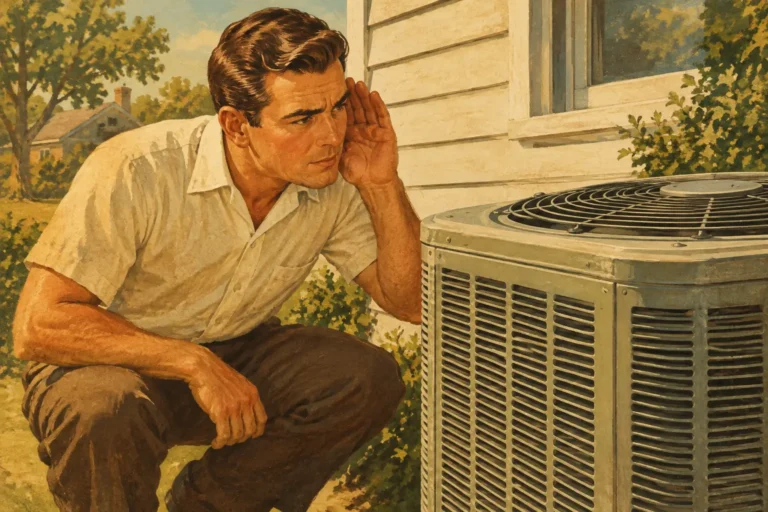
Air Conditioner Noise Troubleshooting Guide
A new sound from the air conditioner often gets your attention at the worst possible time: during a humid Illinois afternoon, when the system is working hardest. This air conditioner noise troubleshooting guide can help you separate a minor issue, such as a loose panel, from a problem that calls for prompt professional repair. The key is to notice what the sound is, where it originates, and whether comfort or system operation has changed.
Before inspecting anything, turn the system off at the thermostat if you smell burning, see smoke, hear loud metal-on-metal grinding, or notice repeated breaker trips. Those symptoms can point to an electrical or mechanical issue that should not be left running.
Start With the Sound and Its Location
Air conditioners make some normal operating sounds. A gentle airflow through supply vents, a soft outdoor fan sound, and an occasional click as the system starts or stops are generally expected. Modern high-efficiency systems may also change their sound slightly as variable-speed components adjust to cooling demand.
What is not normal is a new, persistent, or rapidly worsening sound. Stand a safe distance from the outdoor unit and listen. Then check whether the sound is coming from the indoor equipment, the vents, or the outdoor condenser. This simple distinction gives a technician useful information and can help you decide how urgently to schedule service.
Do not remove electrical panels or reach into the outdoor unit. Even when the thermostat is off, HVAC equipment can retain electrical hazards.
Air Conditioner Noise Troubleshooting Guide by Sound
Rattling or vibrating
Rattling is often one of the less serious noises, but it still deserves attention. The outdoor unit may have a loose cabinet panel, fastener, fan guard, or debris caught around the condenser. Twigs, leaves, and small stones can create a surprising amount of noise when the fan starts.
From outside the unit, without opening it, look for visible debris and check that the equipment is clear of landscaping. A loose window, vent cover, or duct register can also rattle as air moves through the home. If the rattling becomes louder during every cooling cycle, or if the unit vibrates excessively, shut it down and arrange an inspection. A loose internal component can damage other parts over time.
Buzzing or humming
A quiet electrical hum may occur briefly during normal operation. A pronounced buzzing, especially if it is new or accompanied by weak cooling, can have several causes. Loose wiring, a failing contactor, a struggling capacitor, a compressor issue, or debris interfering with the outdoor fan are all possibilities.
Because buzzing can involve electrical components, this is not a do-it-yourself repair. If the outdoor unit hums but the fan does not turn, turn the air conditioner off. Continuing to call for cooling can place additional strain on the compressor, which is one of the system's most expensive components.
Squealing or screeching
A high-pitched squeal from indoor equipment can indicate a blower motor problem, a worn belt on an older system, or a bearing beginning to fail. In some cases, restricted airflow contributes to the strain. Check the air filter first. A heavily loaded filter can make the system work harder and reduce comfort throughout the house.
Replace a dirty filter with the correct size and type recommended for your system. If the squealing persists after replacement, schedule service rather than waiting for it to go away. Motor and bearing problems rarely improve on their own.
Grinding, scraping, or metal-on-metal sounds
Grinding and scraping are urgent noises. They can signal worn motor bearings, a loose fan blade, or a damaged compressor component. If a fan blade is contacting a housing or guard, running the equipment can cause further damage quickly.
Turn the thermostat to off and contact a qualified HVAC professional. For businesses, acting early can protect tenant comfort, customer experience, and equipment budgets. For homeowners, it can prevent a repairable issue from becoming an unexpected replacement decision.
Banging, clanking, or knocking
A bang at startup or shutdown can sometimes come from ductwork expanding and contracting, particularly when temperatures are extreme. Repeated clanking from the outdoor unit, however, may indicate a loose or broken component, an imbalanced fan, or a compressor problem.
Listen for timing. Does the noise happen only when cooling begins, throughout the cycle, or as the unit powers down? Make a brief note or record a short video from a safe distance. That information can speed up diagnosis during a service visit.
Clicking that will not stop
One click when the system starts and another when it stops is common. Repeated clicking without the air conditioner starting is different. It may point to a thermostat issue, electrical control problem, or a component that is failing to engage.
Check that the thermostat has fresh batteries if it uses them, is set to cool, and is set below the current indoor temperature. If the system continues clicking or cycles on and off repeatedly, leave it off until it can be evaluated. Short cycling increases wear and can drive up energy use.
Whistling or loud airflow
Whistling near vents often comes down to airflow. A clogged filter, closed supply registers, undersized ductwork, or duct leaks can create noise and uneven temperatures. Start with the filter and make sure supply vents are open and unobstructed by furniture, rugs, or curtains.
Do not close multiple vents in an attempt to force more air into another room. That strategy can increase duct pressure and create other comfort problems. Persistent whistling may call for a professional airflow and ductwork assessment, especially in homes with hot upper floors, recent renovations, or rooms that never seem to cool evenly.
Safe Checks You Can Make Before Calling
A few observations can help without putting you at risk. Confirm that the filter is clean, the thermostat is correctly set, and the outdoor unit has clear space around it. Look for obvious leaves or debris around the exterior, but do not spray inside the cabinet or try to straighten fan blades.
Also pay attention to performance. Is the home cooling normally? Is there water near the indoor unit? Has an energy bill changed sharply? Does the breaker trip when the system starts? Noise paired with poor cooling, ice on refrigerant lines, a burning odor, or water where it should not be is a strong reason to schedule professional service promptly.
When a Repair Cannot Wait
Some sounds are best handled before the next convenient appointment. Shut the system down and seek prompt help for grinding, screeching, persistent electrical buzzing, burning smells, smoke, repeated breaker trips, or a fan that fails to spin. If the equipment is loud enough to disrupt normal conversation or suddenly stops cooling, avoid repeatedly restarting it.
For property managers and business owners, a noisy rooftop unit or split system should be addressed before it interrupts operations or creates a comfort complaint. Documentation of the sound, its timing, and any thermostat alerts can help a technician work efficiently.
Prevent Noise With Seasonal Maintenance
Many air conditioner noises begin with ordinary wear that preventive maintenance can catch early. During a professional tune-up, the technician can inspect electrical connections, test capacitors, examine motors and fan components, verify refrigerant performance, clean applicable components, and identify vibration or airflow concerns.
Maintenance does not eliminate every repair, and older equipment may eventually need more than a tune-up. Still, it gives you clearer information about the system's condition before a heat wave puts it under maximum demand. For Northeast Illinois homeowners and businesses, that preparation matters when summer humidity arrives quickly.
Lea Heating & Air Conditioning provides responsive repair and maintenance support backed by factory-trained, NATE-certified expertise. If a sound feels wrong, trust that instinct. Turning the system off when necessary and getting a clear diagnosis early is often the most practical way to protect comfort, safety, and the life of your equipment.
A Chicago-area winter exposes the strengths and limitations of a heating system quickly. If some rooms feel dry and drafty while others overheat, or if a radiator takes too long to warm up, the boiler versus furnace question becomes more than a technical comparison. It is about how your home feels on the coldest morning of the year, what it costs to operate, and what equipment makes sense when replacement time arrives.
Both systems can provide reliable, efficient heat. The better choice depends on your home’s existing infrastructure, comfort priorities, fuel options, budget, and plans for cooling. A qualified HVAC assessment should look beyond the equipment label to consider sizing, insulation, ductwork or piping condition, and the way your household actually uses each space.
Boiler Versus Furnace: The Basic Difference
A furnace heats air and distributes it through ducts using a blower. In most Northeast Illinois homes, the furnace burns natural gas, although electric and oil models also exist. Warm air travels through supply vents, while return ducts bring cooler air back to the unit to be reheated.
A boiler heats water rather than air. That hot water, or in some older systems steam, moves through pipes to radiators, baseboards, or radiant-floor tubing. The heat then radiates gently into the room. Boilers may use natural gas, propane, oil, or electricity, depending on the model and the property.
This difference affects nearly every part of the ownership experience. A furnace is part of a forced-air system, which can also support central air conditioning, filtration, humidification, and certain indoor-air-quality accessories. A boiler is part of a hydronic system, valued for its even, quiet warmth, but it usually needs separate equipment for whole-home air conditioning.
Comfort: Moving Air Versus Radiant Heat
Many homeowners notice the comfort difference before they understand the mechanical difference. Forced-air heat reaches a set temperature relatively quickly, which is useful when the thermostat has been turned down overnight or a commercial space needs a fast warm-up. The trade-off is that air movement can create mild drafts, carry dust if filtration is neglected, and produce greater temperature variation between rooms.
Boiler heat tends to feel more gradual and consistent. Radiators and radiant floors warm nearby surfaces and occupants, so rooms can feel comfortable without the noticeable airflow of a furnace. Radiant-floor systems are especially appealing in bathrooms, basements, and rooms with tile flooring.
Neither experience is automatically better. A properly designed variable-speed furnace with balanced ducts can deliver exceptionally consistent comfort while operating quietly. Likewise, an aging boiler with poorly balanced radiators, failing circulators, or outdated controls can leave parts of a home chilly. Installation quality and maintenance matter as much as the type of heat.
Humidity and indoor air considerations
Because furnaces circulate air, they can be paired with whole-home humidifiers, high-efficiency filtration, UV air purifiers, and fresh-air solutions. That flexibility can be valuable for families concerned about dry winter air, allergies, or airborne particles.
Boilers do not blow air, which means they do not spread dust through ducts. They also do not dry the air in the literal sense, although heated winter air can still feel dry as indoor relative humidity drops. Homes with boilers can use standalone or integrated humidity and air-cleaning solutions, but the approach is typically more customized.
Efficiency Depends on Equipment and the Home
Modern high-efficiency furnaces can achieve annual fuel utilization efficiency ratings of 95% or more. High-efficiency condensing boilers can reach similar levels. In simple terms, both can convert a large share of their fuel into usable heat when they are correctly sized, installed, and maintained.
A high efficiency rating does not guarantee low utility bills on its own. An oversized furnace may cycle on and off too often. Leaky ducts can waste heated air in an attic, crawl space, or unfinished basement. A boiler may lose performance if its controls are outdated, pipes are poorly insulated, or the system is not balanced across heating zones.
For a replacement project, the contractor should perform a load calculation rather than selecting equipment based only on the size of the old unit. The right capacity accounts for square footage, ceiling height, windows, insulation, home orientation, and local winter design temperatures. This is one of the most meaningful steps in protecting comfort and energy performance.
Installation Cost and Replacement Practicality
For a home that already has functioning ductwork, replacing a furnace is often more straightforward than converting to a boiler. The same is generally true in reverse: if a home has radiators or hydronic baseboards in good condition, installing a new boiler can be a sensible path with less disruption.
Changing from one system type to another can be a major renovation. Adding ducts to a home built around radiators may require soffits, wall openings, and careful planning around finished areas. Converting from forced air to hydronic heat involves adding piping, emitters, and potentially new electrical or venting requirements. The project can be worthwhile for a substantial remodel, but it is rarely a simple equipment swap.
Homes with boiler heat also need a separate cooling strategy if central air is desired. Ductless mini-splits can provide efficient cooling and supplemental heating without adding full ductwork. High-velocity systems or conventional central air may fit some homes, depending on their construction. The best option should be based on the home’s layout rather than a one-size-fits-all recommendation.
Maintenance and Service Needs
Both systems deserve annual professional maintenance before the heating season. A furnace tune-up typically includes checking combustion, inspecting the heat exchanger, cleaning components, testing safety controls, evaluating airflow, and replacing or checking the filter. Filter changes between visits remain an important homeowner responsibility.
Boiler maintenance includes combustion and safety checks, an inspection for leaks or corrosion, pressure verification, expansion-tank evaluation, and testing of circulators, valves, and controls. Steam boilers have additional maintenance considerations, including water-level controls and proper piping performance.
Furnaces have more moving air-related components, especially the blower and duct system. Boilers have pumps, valves, piping, and water-pressure components. Neither is maintenance-free, and both need prompt attention when warning signs appear.
Call for service if a furnace begins making banging or squealing sounds, cycles repeatedly, has weak airflow, or produces unusual odors. Boiler concerns include water around the unit, pressure changes, cold radiators, noisy pipes, or a system that repeatedly needs water added. If you smell gas or a carbon monoxide alarm activates, leave the building and contact emergency services and your utility provider before arranging HVAC service.
Which System Is Right for Your Property?
A furnace often makes the most sense for homes that already have ducts, want central air conditioning through the same distribution system, or need the flexibility to add whole-home air-quality equipment. It can also be a practical choice for many commercial spaces that require fast recovery and centralized control.
A boiler may be the stronger choice when a home already has a well-maintained hydronic system, the owner values quiet radiant comfort, or zoning is a high priority. Hydronic heating can serve different areas with separate thermostats and control valves, though forced-air zoning is also possible when the duct design and equipment support it.
For older homes in Elgin, Barrington, Crystal Lake, and surrounding communities, preserving a dependable radiator system can be an excellent decision. For a newer home with central ductwork and an aging gas furnace, upgrading to a properly sized high-efficiency furnace may be the most cost-effective path. The answer depends on the home, not on a universal winner.
Make the Decision With a Full-System View
Before replacing either system, ask for clear options that compare equipment efficiency, expected installation scope, warranty coverage, controls, maintenance needs, and cooling implications. A low initial price can become less appealing if it leaves unresolved duct issues, inconsistent rooms, or an outdated thermostat that limits performance.
Lea Heating & Air Conditioning brings factory-trained, NATE-certified expertise to these conversations, with recommendations built around the property and the people using it. Whether you are managing an urgent no-heat call or planning a long-term upgrade, the goal is dependable warmth, safe operation, and a system you can feel confident relying on when winter settles in.
A heat pump that runs constantly, leaves one room chilly, or sends your electric bill climbing is not always facing a major failure. Often, it is asking for attention. Consistent heat pump maintenance keeps small issues from becoming inconvenient breakdowns during a Northeast Illinois cold snap or a humid summer stretch.
Unlike a conventional furnace or air conditioner, a heat pump works throughout the year. It moves heat indoors during winter and removes it from your home in summer. That year-round workload makes professional care and a few simple homeowner habits especially valuable. The goal is not simply to avoid repairs. It is to protect dependable comfort, efficient operation, and the useful life of your equipment.
Why Heat Pump Maintenance Matters in Every Season
Heat pumps have more moving parts and operating modes than many homeowners realize. The outdoor unit, indoor coil, blower, refrigerant system, electrical connections, drain line, thermostat, and defrost controls must work together correctly. A small restriction or calibration issue in one area can affect comfort across the whole system.
A dirty air filter, for example, reduces airflow over the indoor coil. The system may run longer to meet the thermostat setting, use more electricity, and put added strain on the blower. Dirt on the outdoor coil can make it harder to transfer heat. In winter, that can reduce heating capacity just when you need it most. In summer, it can make indoor humidity harder to control.
Regular service also gives a trained technician the opportunity to find developing problems before they become urgent. A loose electrical connection, weak capacitor, worn contactor, refrigerant concern, or drainage issue may not stop the system today. Left alone, however, it can lead to a no-heat or no-cooling call when demand is highest.
For commercial properties, the stakes can be even higher. Uneven temperatures can affect employee comfort, customer experience, sensitive equipment, and operating costs. Planned maintenance helps property managers address performance concerns on a schedule rather than under pressure.
What You Can Do Between Professional Visits
Homeowners do not need to take apart a heat pump to care for it. A few routine checks can make a meaningful difference and can help you spot trouble earlier.
Start with the air filter. Check it monthly during periods of heavy heating or cooling use and replace it when it looks dirty or according to the filter manufacturer’s recommendation. The right interval depends on the filter type, household size, pets, allergies, remodeling activity, and how often the system runs. A filter that is too restrictive can also cause airflow problems, so use the type recommended for your system.
Keep the outdoor unit clear. Leaves, grass clippings, snow, shrubs, and stored items can block airflow around the coil. Maintain open space around the unit and gently remove loose debris from the exterior. Do not use a pressure washer, sharp tools, or aggressive brushing on the coil fins. Those fins bend easily, and damaged coils can restrict airflow.
Pay attention to what normal operation looks and sounds like. Your heat pump may make a noticeable change in sound when switching modes, and defrost cycles are normal in cold weather. During defrost, you may see steam rising from the outdoor unit and hear the system briefly change operation. That is different from persistent grinding, rattling, buzzing, or frequent on-and-off cycling.
Finally, keep supply vents and return grilles open and unobstructed. Closing too many vents to control individual rooms can interfere with system airflow and may not produce the savings you expect. If some rooms are consistently uncomfortable, the better answer could be thermostat adjustments, duct improvements, zoning, or an equipment evaluation.
What Professional Heat Pump Maintenance Includes
A professional tune-up is more than changing a filter and looking over the outdoor cabinet. A thorough visit should evaluate the system’s performance, safety, and condition while it is operating.
Technicians typically inspect and clean accessible indoor and outdoor coils as needed, check electrical components, test capacitors and controls, inspect wiring, evaluate refrigerant performance, confirm proper airflow, and examine the condensate drain. They also assess the blower assembly, thermostat operation, and the condition of accessible duct connections.
For heat pumps, the defrost system deserves special attention. The outdoor coil can accumulate frost in heating mode, particularly during damp and cold Illinois weather. The unit is designed to periodically defrost itself. If the defrost controls, sensors, or reversing valve are not functioning properly, frost can build up and reduce heating performance.
A technician should also verify that auxiliary or backup heat is operating as intended. Many heat pump systems use electric heat strips, while dual-fuel systems may use a gas furnace for backup heat. The best balance between heat pump operation and backup heat depends on the equipment, controls, home construction, utility costs, and outdoor temperature. It is not a setting that should be guessed at.
Maintenance does not mean a technician will automatically add refrigerant. Refrigerant operates in a closed system and should not be routinely “topped off.” If levels are low, that can indicate a leak or another issue that needs proper diagnosis and repair.
When to Schedule Service
Most heat pumps benefit from professional maintenance twice a year: once before the cooling season and once before the heating season. Because the same equipment carries both loads, spring and fall visits help ensure the system is ready for its next major demand period.
That schedule can vary. A newer system in a lightly used home may have different needs than a unit serving a busy household, a pet-friendly home, a commercial space, or a property with indoor-air-quality concerns. Still, annual service should be the minimum for a system that provides year-round heating and cooling.
Do not wait for a routine appointment if you notice warning signs. Schedule a diagnostic visit if your heat pump is blowing cool air in heating mode when it is not defrosting, producing weak airflow, making new noises, leaking water indoors, icing heavily, tripping breakers, or running much longer than usual. Sudden increases in utility bills also deserve attention, especially if your comfort habits have not changed.
Common Maintenance Mistakes to Avoid
The most expensive maintenance mistake is ignoring a change because the system still runs. Heat pumps can continue operating while losing efficiency or placing stress on components. Waiting until complete failure often limits your options and can turn a minor repair into a larger one.
Another mistake is covering the outdoor unit tightly for the winter. Heat pumps need to operate outdoors in winter, so they should never be wrapped or enclosed during the heating season. If debris protection is needed during a period when the unit is completely off, use a manufacturer-approved approach that does not trap moisture or create a shelter for pests.
It is also wise to avoid repeatedly changing thermostat settings by large amounts. Heat pumps generally perform best with steady, reasonable settings. Large setbacks can trigger more backup heat operation on some systems, which may increase energy use. A smart thermostat configured for heat pump operation can help, but it needs to be compatible and set up correctly.
Comfort Is the Real Measure of Good Maintenance
A well-maintained heat pump should deliver even, dependable comfort without constant thermostat adjustments or surprising energy costs. It should also give you confidence that your equipment has been inspected by people who understand its heating, cooling, electrical, and control systems.
For homeowners and businesses in the northwest suburbs, Lea Heating & Air Conditioning provides maintenance from factory-trained, NATE-certified technicians who can explain what they find clearly and recommend options based on your system and comfort goals. Scheduling service before extreme weather arrives is a practical way to protect the comfort you rely on every day.
A carbon monoxide alarm is not a maintenance reminder you can put off until the weekend. If it sounds, the safest response is to get people and pets outside immediately, call 911 or the fire department from a safe location, and do not reenter until emergency personnel say it is safe. Carbon monoxide safety depends on treating this invisible, odorless gas as the serious emergency it is.
Carbon monoxide, often called CO, is created when fuel does not burn completely. Natural gas, propane, oil, wood, charcoal, and gasoline-burning equipment can all produce it. In a home or business, the risk usually comes from a malfunctioning appliance, blocked venting, inadequate combustion air, or equipment used where it should never be used.
Why Carbon Monoxide Safety Requires More Than an Alarm
A CO alarm is essential, but it is the last line of defense, not the whole plan. It warns occupants that carbon monoxide has reached a dangerous concentration. It cannot repair a cracked heat exchanger, clear a blocked flue pipe, or correct an improperly vented water heater.
That is why a complete approach combines reliable alarms, safe equipment operation, professional maintenance, and a clear response plan. This matters especially during Northeast Illinois winters, when furnaces, boilers, fireplaces, and space heaters work harder and windows stay closed for long stretches.
Carbon monoxide exposure can cause headache, dizziness, nausea, weakness, confusion, chest pain, and flu-like symptoms without a fever. Severe exposure can lead to loss of consciousness or death. Symptoms may be harder to recognize in sleeping people, young children, older adults, and anyone who has been drinking alcohol or taking medication that causes drowsiness. Never wait for symptoms before acting on an alarm.
Where Carbon Monoxide Can Come From
Most fuel-burning equipment operates safely when it is installed, vented, and maintained correctly. Problems arise when combustion or exhaust pathways change. A furnace with a damaged vent connection, a boiler with a blocked chimney, or a water heater starved for combustion air may not operate as intended.
Common sources include gas furnaces and boilers, fireplaces, gas water heaters, ranges, clothes dryers, and attached garages. Portable generators, grills, camp stoves, and propane heaters create particularly high risks when used indoors or too close to doors, windows, or vents.
An attached garage deserves special attention. Even with the garage door open, a running vehicle can create dangerous CO levels. Do not idle a car, truck, snowblower, or other gasoline-powered equipment in an attached garage. Move the vehicle outside before warming it up, and keep the door between the garage and living space closed.
For commercial properties, risks may also involve unit heaters, make-up air equipment, rooftop systems, warehouse loading areas, and mechanical rooms. Occupants may not notice a developing issue until alarms activate or several people report similar symptoms. Property managers should ensure employees know who to call and where to evacuate if a CO alarm sounds.
Place and Maintain Carbon Monoxide Alarms Correctly
Install CO alarms on every level of a home, outside sleeping areas, and according to the manufacturer’s instructions. Larger homes, multi-level townhomes, and properties with bedrooms separated by long hallways may need more than the minimum number of alarms. Follow local code requirements as well as the alarm manufacturer’s placement guidance.
Avoid placing alarms directly beside fuel-burning appliances, where normal startup conditions could create nuisance alerts, unless the manufacturer specifically allows it. Do not paint over an alarm, cover it, or install it in a location where furniture blocks airflow. A qualified HVAC professional can help identify sensible locations when you are unsure.
Test alarms monthly using the test button. Replace batteries as directed for battery-operated models, and replace the entire device when it reaches the end of its listed service life. Many alarms need replacement after five to 10 years, depending on the model. Check the label rather than guessing.
If an alarm chirps, it may indicate a low battery, end of life, or fault condition. That is different from a full alarm signal, but it still needs prompt attention. Read the device instructions and replace batteries or the unit as needed. Never remove batteries to silence a chirp and forget about it.
What to Do When a CO Alarm Sounds
The right response is simple, even if it feels disruptive: leave first, investigate later. Do not search the home for the source, open windows as your only response, or assume the alarm is defective because no one feels sick.
If the CO alarm sounds, follow these steps:
- Move everyone outside to fresh air, including pets.
- Call 911 or the local fire department from outside. If anyone has symptoms, seek medical care immediately.
- Do not go back inside to reset the alarm, collect belongings, or turn off equipment.
- Allow emergency responders to determine whether it is safe to reenter.
- After the immediate emergency is resolved, arrange for qualified inspection and repair of the suspected fuel-burning equipment before using it again.
Opening windows can help ventilate a space, but it does not identify the source or make it safe to remain indoors. Carbon monoxide levels can change quickly as equipment cycles on and off. A professional inspection is the only responsible next step after an alarm event involving HVAC or water-heating equipment.
Reduce the Risk With Safe Habits and Seasonal Service
Many CO hazards are preventable. Start with the equipment you use every day. Keep furnace, boiler, water-heater, and fireplace venting clear of snow, leaves, nests, and other debris. After heavy snowfall, check exterior intake and exhaust terminations carefully. A blocked vent can affect performance and create a safety concern.
Never heat a home with a gas oven or range. Do not operate charcoal grills, generators, pressure washers, or gasoline-powered tools indoors, in garages, in basements, or near open windows and doors. Portable generators should operate outdoors, well away from the building, with exhaust directed away from occupied areas.
Space heaters require caution, too. Use only equipment rated for indoor use, keep it on a stable surface, and follow the manufacturer’s clearance instructions. Unvented combustion heaters may not be appropriate for every space. If you rely on one during an outage or in a workshop, understand the ventilation requirements and never use it while sleeping unless it is specifically designed and approved for that purpose.
Annual professional heating maintenance is one of the most practical ways to reduce carbon monoxide risk. During a properly performed visit, a trained technician can inspect burners, heat exchangers, vent connections, drains, safeties, combustion conditions, and overall system operation. The exact checks vary by equipment type, but the goal is the same: identify concerns before they become an emergency.
Older equipment deserves particular attention. Age alone does not mean a furnace or boiler is unsafe, but wear, corrosion, outdated venting, and repeated repair history can change the conversation. A technician should explain the condition of the system, the available repair options, and whether replacement may be the safer long-term investment. The right choice depends on the equipment, the building, and the nature of the problem.
When to Call an HVAC Professional
Call for service promptly if you notice soot around an appliance, excessive moisture on nearby windows, yellow or flickering burner flames where blue is expected, unusual odors, recurring pilot-light problems, or a heating system that frequently shuts down. These signs do not confirm carbon monoxide, but they warrant inspection.
A CO alarm activation, however, is not a routine service call until the building has been cleared by emergency responders. Once it is safe, do not restart the furnace, boiler, water heater, or other suspected appliance yourself. Have a qualified technician assess the equipment and venting before returning it to service.
For homeowners and businesses in the Elgin area, Lea Heating & Air Conditioning can provide professional heating-system inspection, repair, and preventive maintenance from factory-trained, NATE-certified technicians. Keeping combustion equipment maintained is not just about dependable heat. It is about protecting the people who rely on your space.
A working alarm, a clear evacuation plan, and properly maintained fuel-burning equipment create real peace of mind. Take care of the small checks now, so your home or business is prepared to respond quickly if carbon monoxide ever becomes a threat.
A furnace that starts rattling at 2 a.m. or an air conditioner that cannot keep up during a July heat wave makes replacement feel urgent. This home HVAC replacement guide helps you make the decision with a clear head, whether your equipment has stopped working or you are planning ahead for better comfort, efficiency, and indoor air quality.
For homeowners in Elgin and throughout Northeast Illinois, the right replacement is rarely just about choosing the highest efficiency rating. Your home’s layout, insulation, ductwork, humidity levels, and the way your family uses each room all affect what will perform well. A properly selected system should deliver dependable heating and cooling without creating new problems such as uneven temperatures, excess noise, or high utility bills.
Know When Replacement Makes More Sense Than Repair
Most HVAC equipment does not fail all at once. It often gives warning signs: frequent service calls, rising energy use, hot and cold rooms, noisy operation, water around the equipment, or a system that runs constantly without reaching the thermostat setting. Age matters too. A well-maintained furnace may operate for 15 to 20 years, while a central air conditioner or heat pump often lasts 12 to 15 years, though maintenance, installation quality, and usage can shorten or extend that range.
A repair can still be the sensible choice when the equipment is relatively new and the issue is isolated. Replacing a worn capacitor, igniter, or control component is very different from facing repeated major repairs on an older system with declining performance. If the repair is expensive, the unit is near the end of its expected life, or it uses an outdated refrigerant, it is worth comparing repair costs against the long-term value of replacement.
Replacement also gives you the chance to correct comfort issues that repairs cannot solve. If the upstairs is always too warm, a bedroom never gets enough airflow, or winter air feels uncomfortably dry, the solution may involve more than a new condenser or furnace. Duct improvements, zoning, a variable-speed system, a humidifier, or a smarter thermostat may be part of a better overall plan.
Start Your Home HVAC Replacement Guide With the Right Assessment
The most important part of an HVAC replacement happens before equipment is ordered. A contractor should evaluate your existing system, ask about comfort concerns, inspect accessible ductwork, and consider the home as a whole. Simply matching the size of the old unit can repeat an old sizing mistake.
Proper sizing is based on a heating and cooling load calculation. This calculation considers square footage, windows, insulation, ceiling height, home orientation, air leakage, and more. A system that is too small may struggle during extreme weather. One that is too large can short-cycle, meaning it starts and stops too often. Short cycling wastes energy, adds wear, and can leave the home clammy in summer because the air conditioner does not run long enough to remove sufficient humidity.
Ask your contractor how the recommended capacity was determined. You should also receive an explanation of whether your ducts can support the new equipment. High-efficiency systems can be particularly sensitive to airflow. Leaky, undersized, or poorly balanced ducts can limit comfort even when the new equipment itself is excellent.
Consider the System Type, Not Just the Brand
A traditional furnace and central air conditioner remain a strong choice for many Illinois homes, particularly where natural gas service is available. A high-efficiency gas furnace can provide reliable winter performance, while a matched air conditioner handles summer cooling.
Heat pumps are another option worth discussing. Modern cold-climate heat pumps provide efficient heating and cooling in one system. Some homeowners choose a dual-fuel arrangement, pairing a heat pump with a gas furnace. In milder weather, the heat pump supplies efficient heat. When outdoor temperatures become very low, the furnace can provide additional capacity. The best choice depends on utility costs, your existing infrastructure, comfort preferences, and the condition of your current equipment.
Ductless mini-splits can be effective for additions, converted garages, rooms with persistent comfort issues, or homes without practical duct access. Boilers remain appropriate for homes with hydronic heat, although cooling may require a separate solution. There is no universal best system. The right one is the system designed around your property and priorities.
Compare Efficiency Ratings in Context
Efficiency ratings help you compare equipment, but they do not tell the whole story. For cooling equipment, look at SEER2. For heat pumps, consider both SEER2 for cooling and HSPF2 for heating. Furnace efficiency is measured by AFUE, the percentage of fuel converted to usable heat.
Higher ratings can reduce operating costs, especially when the system is used heavily. They may also bring comfort advantages. Variable-speed blowers, two-stage furnaces, and variable-capacity heat pumps can run at lower output for longer periods. That typically means quieter operation, steadier temperatures, and improved humidity control.
Still, the highest-rated option is not always the best value. A premium system may be worthwhile for a long-term homeowner who wants precise comfort control and lower energy use. A simpler, efficient single-stage system may be a practical fit for a rental property, a smaller home, or a homeowner with a different budget. Your contractor should present clear options and explain the trade-offs without pressure.
Look Beyond the Equipment Quote
A replacement proposal should describe more than the model number and price. Installation quality has a direct effect on safety, efficiency, lifespan, and comfort. Ask what is included for electrical work, refrigerant-line adjustments, drain protection, venting, permits, thermostat setup, startup testing, and removal of old equipment.
If your system has existing airflow or comfort problems, ask whether duct sealing, duct modifications, or balancing are recommended. If you are replacing only one part of a split system, such as the outdoor air conditioner, confirm that it is properly matched to the indoor coil and blower. Mismatched components can compromise efficiency and performance.
Also ask about warranty coverage and who will perform future maintenance and repairs. Manufacturer parts warranties are valuable, but dependable local service matters when a problem occurs on a cold winter night or a humid summer weekend. Factory-trained, NATE-certified technicians and a contractor with a long local history can provide added confidence that the system will be installed and supported correctly.
Plan for Budget, Timing, and Financing
HVAC replacement is a major home investment, and cost varies widely based on equipment type, capacity, efficiency level, duct changes, electrical needs, and accessories. Avoid making a decision based on the lowest initial quote alone. A lower price may leave out necessary work that protects performance and reliability.
Instead, compare proposals line by line. Consider the expected operating cost, warranty, installation scope, available financing, and the contractor’s service reputation. A clear proposal should help you see why one option costs more and what practical benefit that difference provides.
If your equipment is still operating, replacing it before an emergency gives you more time to compare options. You can schedule around your household, review efficiency choices, and avoid making a rushed decision during severe weather. If the system has failed, an experienced contractor can still guide you quickly through the process and identify safe temporary options when needed.
Prepare for Installation Day
Most standard residential replacements can be completed in a day, although more involved projects may take longer. Before the crew arrives, clear a path to the furnace, air handler, indoor coil, electrical panel, and outdoor unit. Keep pets secure and plan for children to stay clear of work areas.
A professional installation team should protect floors and work areas, communicate throughout the project, and leave the space clean. Once the equipment is installed, the job is not complete until the system has been tested. That includes checking airflow, temperature performance, refrigerant operation where applicable, combustion safety for gas equipment, drainage, and thermostat operation.
Before the team leaves, make sure you understand how to operate the thermostat, change filters, and recognize when to call for service. Keep your model and serial numbers, warranty information, and maintenance records in a safe place.
Protect the Investment After Replacement
Even the best new system needs regular care. Change filters on schedule, keep outdoor equipment clear of leaves and snow, and arrange professional maintenance before the heating and cooling seasons. Preventive service helps identify small issues before they become breakdowns and supports efficient operation over time.
Lea Heating & Air Conditioning can help homeowners evaluate replacement options with individualized recommendations, clear installation details, and ongoing service support. The goal is not merely new equipment. It is a home that feels consistently comfortable, runs efficiently, and is ready for the weather Illinois brings next.
A second-floor bedroom that never cools down, an older Elgin home without ducts, and an office addition with hot afternoons can all lead to the same question: central air versus ductless cooling. Both can provide reliable summer comfort, but they solve different problems. The better choice depends on your building layout, existing equipment, renovation plans, comfort priorities, and budget.
Central air remains a strong whole-home solution when ductwork is in good condition. Ductless cooling, often called a mini-split system, offers targeted temperature control without requiring supply and return ducts. Neither option is automatically right for every property. A professional load calculation and an honest look at the building are what turn a cooling purchase into a long-term comfort solution.
Central Air Versus Ductless Cooling: The Core Difference
A central air conditioner uses one outdoor condensing unit and an indoor evaporator coil, usually installed with a furnace or air handler. Conditioned air travels through ductwork to rooms throughout the home or business. A thermostat controls the system, although zoning equipment and smart thermostats can add more precision.
A ductless system uses an outdoor unit connected to one or more indoor air handlers by small refrigerant lines and wiring. Each indoor unit serves a specific room or zone and has its own temperature control. The installer does not need to run large ducts through walls, attics, or crawlspaces, which makes ductless equipment especially useful in homes with limited access for ductwork.
The difference is not simply central system versus wall unit. Modern ductless systems are engineered HVAC equipment with variable-speed technology, filtration, condensate drainage, and carefully sized refrigerant lines. Proper design and installation matter just as much as the equipment itself.
When Central Air Is the Better Fit
Central air is often the practical choice for a home that already has a forced-air furnace and well-designed ducts. If every room needs cooling at roughly the same time, one properly sized central system can deliver consistent whole-home comfort without placing an indoor unit in each living area.
For many homeowners, the appearance of the system is also a factor. Central air keeps the major components out of sight, with only registers and returns visible indoors. It can be a natural replacement option when an existing air conditioner is aging, especially if the furnace, coil, and ductwork are compatible with a high-efficiency upgrade.
Central systems can also support whole-home accessories. Depending on the equipment and duct design, that may include advanced filtration, humidification, UV air purification, and zoning controls. For families concerned about comfort and indoor air quality across the entire house, this integrated approach has real value.
That said, central air depends heavily on the duct system. Leaky, undersized, poorly insulated, or unbalanced ducts can waste energy and create frustrating temperature differences between rooms. Replacing the outdoor unit alone will not correct a ductwork problem. In some cases, duct repairs, balancing, or zoning should be part of the project scope.
Where Ductless Cooling Makes Sense
Ductless cooling is especially effective when extending or installing ductwork would be disruptive or costly. Common applications include finished basements, attic conversions, sunrooms, garages, home offices, additions, older homes, and individual rooms that never seem to match the rest of the house.
Because each indoor head serves a zone, ductless systems give occupants direct control. A couple may keep the bedroom cooler at night without overcooling the first floor. A business can condition a server room, conference room, or office addition without running the main system longer than necessary. This room-by-room control can reduce energy waste when only part of a building is occupied.
Many ductless heat pumps also provide heating, making them useful beyond the cooling season. In Northeast Illinois, a cold-climate heat pump can supplement a furnace or serve selected spaces efficiently during milder weather. However, winter performance and backup heat requirements should be discussed carefully. Equipment selection must account for local design temperatures, the building envelope, and how the space will be used.
The indoor units are visible, which some homeowners see as a drawback. Wall-mounted units are common, but ceiling cassettes, floor-mounted models, and concealed ducted options may be available depending on the application. A good design considers sightlines, airflow, service access, and how the equipment will look in the finished room.
Cost Is More Than the Equipment Price
Comparing purchase prices alone can be misleading. A central air replacement may cost less upfront when usable ductwork and a compatible furnace are already in place. If ducts must be added throughout an older home, however, installation labor and construction work can make central air far more expensive.
Ductless systems can avoid much of that disruption, but multi-zone installations are not necessarily inexpensive. Each indoor zone requires equipment, refrigerant piping, electrical work, drainage, and careful commissioning. A single ductless unit for a sunroom is a very different project from a whole-home multi-zone system.
Operating costs also vary. High-efficiency central air and ductless systems can both lower energy use compared with older equipment. Ductless units often gain an advantage in lightly used areas because they cool only the occupied zone. Central air may be more economical for a home where the entire space is occupied daily and the duct system is tight, insulated, and properly balanced.
Efficiency ratings help, but they should not be the only deciding factor. An oversized high-efficiency system can short cycle, remove less humidity, and wear prematurely. An undersized system may struggle during a heat wave. Correct sizing starts with a room-by-room load calculation rather than square footage alone.
Comfort, Humidity, and Noise
Cooling is about more than reaching a thermostat setting. A system should manage humidity, move air comfortably, and avoid wide temperature swings. Central air distributes conditioned air broadly, which can create an even feel throughout a well-designed home. Variable-speed systems can improve humidity control by running longer at lower output when conditions allow.
Ductless systems deliver air directly into the rooms they serve. That can be ideal for a stubborn hot room, but the indoor unit must be located correctly. Poor placement can send airflow across a bed, desk, or seating area in a way that feels drafty. It may also leave adjoining rooms without enough circulation.
Both options can operate quietly when selected and installed properly. Ductless indoor units are generally quiet, while central systems may produce more audible airflow if ducts are restrictive or registers are poorly located. Noise concerns are another reason to evaluate the complete system, not just the outdoor unit.
Maintenance Requirements Are Different, Not Optional
Every cooling system benefits from routine professional maintenance. Central air service includes checking refrigerant performance, electrical components, condensate drainage, blower operation, coils, and airflow. Homeowners should also replace or clean filters on schedule, because a clogged filter restricts airflow and can affect comfort and equipment reliability.
Ductless systems need the same level of professional attention, along with regular cleaning of indoor filters, coils, blower wheels, and condensate components. Since the indoor heads handle air directly in occupied rooms, neglected cleaning can affect airflow, odor, and system performance. Multi-zone systems also require technicians who understand how to diagnose controls and refrigerant circuits across multiple indoor units.
For either system, preventive maintenance is less disruptive than waiting for a failure during the hottest week of summer. It also gives a technician an opportunity to identify drainage, electrical, or airflow issues before they become a no-cooling call.
Questions to Settle Before Choosing
Start with the building, not a preferred product. Does the property have ducts, and are they properly sized and sealed? Are you cooling the whole home or solving a problem in one area? Is there a planned addition, renovation, or change in occupancy? Do different family members need different temperatures in separate rooms?
For commercial properties, also consider operating hours, occupied zones, equipment heat loads, tenant needs, and downtime risk. A ductless system may be a smart targeted solution, while a central system may better support a larger, consistently occupied area. In some buildings, the best answer is a hybrid approach: central air for the main space and ductless equipment for an addition, bonus room, or persistent trouble spot.
A qualified HVAC contractor should inspect existing ducts, electrical capacity, insulation, drainage paths, outdoor-unit location, and the condition of related equipment. Ask for clear options, expected comfort results, maintenance needs, and any work required beyond the equipment itself. The right proposal should explain why a system is recommended, not merely present a model number.
Lea Heating & Air Conditioning helps homeowners and businesses evaluate those details with factory-trained, NATE-certified expertise and a focus on clean, dependable workmanship. Whether the answer is a central replacement, a ductless zone, or a combined design, the goal is the same: dependable comfort that fits the way your space is actually used.
Before the next heat wave makes the decision urgent, schedule a professional evaluation and give the conversation a practical starting point: which rooms need better comfort, when are they occupied, and what is your current system failing to do?
An air conditioner can look efficient on a proposal and still be the wrong fit for your home. The rating matters, but so do your ductwork, cooling habits, insulation, humidity needs, and the quality of the installation. This air conditioner SEER2 guide explains what the number means, where it helps, and how to make a replacement decision you can feel good about for years.
What Does SEER2 Mean on an Air Conditioner?
SEER2 stands for Seasonal Energy Efficiency Ratio 2. It measures how efficiently a central air conditioner or heat pump provides cooling across a range of outdoor conditions during a typical season. Put simply, it compares the amount of cooling delivered with the electricity used to produce it. A higher SEER2 number indicates greater seasonal efficiency.
SEER2 replaced the older SEER rating in 2023. The newer test procedure is designed to reflect real operating conditions more closely, including higher external static pressure. Static pressure is the resistance air encounters as it moves through ducts, filters, registers, and other parts of the system. Because the test is more demanding, a SEER2 rating is usually numerically lower than the comparable older SEER rating.
That does not mean the equipment became less efficient. It means the industry began using a different measurement standard. As a rough reference, 14.3 SEER2 is often comparable to the former 15 SEER level, though conversions are not exact across every type of equipment.
For many newly installed split-system air conditioners in Northern Illinois, 13.4 SEER2 is the current federal minimum. Equipment above that threshold may reduce cooling electricity use, but the best choice depends on more than the label.
Why the SEER2 Rating Matters in Northeast Illinois
Cooling in Elgin and the surrounding suburbs is not the same as cooling in a long, hot Southern summer. Our region has humid stretches, heat waves, and plenty of warm days, but the annual cooling season is shorter than it is in warmer climates. That affects the financial return you may see from moving to a very high-efficiency air conditioner.
A higher SEER2 system can still be a smart investment, especially when replacing an older unit that is losing capacity, needs frequent repairs, or uses outdated components. It can lower electricity consumption during the cooling season and may provide better temperature consistency. But a homeowner who rarely uses air conditioning may not recover the added equipment cost as quickly as a household that runs its system heavily from late spring through early fall.
Efficiency is also about comfort. Many higher-SEER2 systems include variable-speed or two-stage technology. Instead of repeatedly turning fully on and fully off, these systems can operate at lower output for longer periods when conditions allow. Longer, steadier run times can help remove more moisture from the air and reduce noticeable temperature swings between rooms.
SEER2 Is Only One Part of the Comfort Equation
It is tempting to compare two air conditioners by their SEER2 ratings and choose the higher number. That approach overlooks details that have a major effect on performance and operating cost.
Proper sizing comes first
An oversized air conditioner can cool a home quickly but shut off before it removes enough humidity. The result may be rooms that feel cool yet clammy, more frequent starts and stops, and uneven temperatures. An undersized system may run for long periods without keeping up during peak heat.
A qualified contractor should perform a load calculation rather than select equipment based solely on the size of the existing unit or the home’s square footage. Window exposure, insulation, ceiling height, air leakage, occupants, appliances, and additions all affect the cooling load. If you have remodeled a basement, finished an attic, replaced windows, or added onto your home, the right system size may have changed.
Ductwork affects real-world efficiency
A 16 SEER2 air conditioner connected to undersized, leaky, or poorly balanced ducts will not deliver the comfort promised by its rating. Restricted airflow can increase static pressure, strain equipment, and leave distant rooms warmer than the thermostat setting.
Before replacement, it is worth evaluating the duct system, filter arrangement, supply and return airflow, and any recurring hot or cold spots. In some homes, targeted duct improvements, zoning, or a properly placed ductless unit can solve comfort problems that a higher-rated condenser alone will not fix.
Installation quality protects your investment
Correct refrigerant charge, electrical connections, condensate drainage, airflow setup, and commissioning all matter. Even premium equipment can lose efficiency and reliability when installed carelessly. Factory-trained, NATE-certified technicians bring the testing and technical knowledge needed to set up the system for dependable operation, not just get it running on installation day.
How Much Can a Higher SEER2 Air Conditioner Save?
Savings depend on what you have now, how much you cool, electricity rates, thermostat settings, and the condition of the entire HVAC system. A household replacing a 10 SEER unit will usually see a more meaningful reduction in cooling energy use than one replacing a relatively recent 14 SEER system.
The percentage difference between ratings can provide a general comparison. For example, a 16 SEER2 system uses less energy to provide the same seasonal cooling than a 13.4 SEER2 system. The actual dollar savings, however, are not guaranteed. Hot summers, extended work-from-home schedules, a new addition, or changes in utility pricing can all shift the results.
Consider the complete cost of ownership rather than focusing only on the initial price or a projected savings figure. A mid-range system with appropriate capacity, solid warranty coverage, professional installation, and regular maintenance can be the better value for many homes. A premium variable-capacity system may make sense for homeowners who prioritize quieter operation, precise comfort, stronger humidity control, and long-term efficiency.
Choosing the Right SEER2 Level for Your Home
There is no universal “best” rating. The practical choice usually falls into one of three situations.
A standard-efficiency system can be appropriate when your existing ductwork is in good condition, your cooling demand is moderate, and controlling the upfront investment is the priority. It should still meet current requirements and provide reliable cooling when selected and installed correctly.
A mid-efficiency system often provides a balanced option for homeowners who want lower operating costs and improved comfort without paying for every available advanced feature. This is commonly a strong fit for established homes in the Northwest suburbs.
High-efficiency equipment is worth considering when you use air conditioning extensively, have persistent humidity or temperature-balance concerns, plan to stay in the home for many years, or want the comfort benefits of variable-speed operation. It can also pair well with smart thermostats, zoning strategies, and broader home-efficiency improvements.
For a business or managed property, the decision should also account for occupancy schedules, equipment runtime, tenant comfort, maintenance access, and the cost of an unexpected failure. Commercial systems use different efficiency measurements in some cases, so a professional evaluation should focus on the equipment type and the building’s actual demands.
Questions to Ask Before You Approve an AC Replacement
Ask whether a load calculation will be completed and whether the proposal includes a review of ducts and airflow. Confirm the exact model number, SEER2 rating, warranty terms, and whether the system uses single-stage, two-stage, or variable-capacity cooling. It is also helpful to ask what comfort improvements you should realistically expect, not just what energy savings may be possible.
A clear proposal should explain your options without pressuring you toward the highest-priced model. Financing may make a higher-efficiency replacement more manageable, but the monthly payment should still fit your budget and your long-term plans for the property.
Routine maintenance matters after installation, too. Keeping filters clean, clearing the outdoor unit of debris, checking drainage, and scheduling professional seasonal service help preserve efficiency and catch small issues before a summer breakdown. Lea Heating & Air Conditioning has served Northeast Illinois for more than 48 years, with factory-trained technicians who can help match system performance to the way your home or business actually operates.
The right SEER2 rating is the one that supports dependable comfort, sensible operating costs, and equipment that is properly sized for your space. Start with an in-home evaluation, ask direct questions, and choose a system built around your needs rather than a number alone.
A furnace that quits during a January cold snap or an air conditioner that struggles through a humid July afternoon rarely fails without warning. Small changes - longer run times, uneven temperatures, unfamiliar sounds, rising utility bills - often begin months earlier. One of the most practical benefits of annual HVAC tuneups is the opportunity to find those concerns before they become an urgent repair call.
For homeowners and business owners in Northeast Illinois, maintenance is not simply a box to check before the seasons change. It is a planned visit that helps protect comfort, safety, equipment performance, and the budget you have set aside for your property.
1. Fewer Surprise Breakdowns
HVAC equipment works hardest when outdoor temperatures are at their most extreme. That is also when a weak capacitor, worn blower component, clogged drain, loose electrical connection, or dirty filter can push a system from “still running” to “not running at all.”
During a professional tuneup, a technician evaluates the system's key operating components and looks for early signs of wear. Addressing a small issue on a scheduled visit is generally easier than responding to a no-heat or no-cooling situation when your system is under maximum demand.
Maintenance cannot guarantee that every future repair will be avoided. Parts can fail unexpectedly, and aging equipment has limits. Still, regular inspections reduce the odds that overlooked wear will become an after-hours emergency.
2. Lower Energy Waste
An HVAC system can run while using more energy than it should. Dirty coils, restricted airflow, incorrect refrigerant performance, and poorly calibrated controls can all make heating and cooling equipment work longer to deliver the same result.
A tuneup helps restore efficient operation by checking airflow, cleaning applicable components, inspecting the filter, and confirming that the system is cycling and operating as intended. For a business with multiple occupants, operating hours, and comfort expectations, even modest inefficiencies can add up over a season. At home, better performance can mean less time listening to the system run without getting the comfort you expect.
Energy savings depend on the condition, age, and type of equipment. A well-maintained high-efficiency heat pump may see a different result than a 15-year-old furnace that is nearing replacement. Maintenance is not a substitute for replacing equipment that has become unreliable or inefficient, but it helps every system operate closer to its intended standard.
3. More Even, Dependable Comfort
Comfort is about more than whether the thermostat displays the temperature you selected. It is also about whether the bedrooms stay warm, whether the second floor gets stuffy, whether air moves consistently, and whether the system responds when the weather shifts.
Annual service gives a trained technician a chance to identify issues that can affect comfort, including airflow restrictions, blower performance, thermostat concerns, ductwork issues, and system cycling problems. These details matter in homes with additions, finished basements, sun-facing rooms, or multiple levels. They also matter in commercial spaces where uneven temperatures can affect employees, customers, and tenants.
If a tuneup reveals a larger comfort concern, the right next step may be a targeted repair, thermostat adjustment, ductwork recommendation, or discussion about zoning. The goal is not to sell a solution that does not fit. It is to give you clear information about why the system is behaving the way it is.
4. Better Indoor Air Quality Support
Your heating and cooling system moves air throughout the building, so its condition affects the environment people breathe every day. A maintenance visit can include checking filters, inspecting drainage and moisture-related concerns, and evaluating components that influence airflow.
A clean filter is especially important, but it is only one piece of the picture. Families with pets, allergy concerns, respiratory sensitivities, or high occupancy may need more frequent filter changes than the standard schedule. Businesses may also need a maintenance plan that reflects their operating hours and the demands placed on their equipment.
When needed, a technician can help you consider additions such as whole-home humidifiers, UV air purifiers, improved filtration, or ventilation-related solutions. These products are not necessary for every property. The best recommendation depends on the building, the existing HVAC system, and the specific air-quality concern you are trying to address.
5. Improved Heating Safety
Furnace maintenance carries a safety benefit that should not be overlooked. Gas-fired heating systems involve combustion, venting, electrical controls, and safety switches that need professional attention. A thorough inspection can identify concerns such as burner issues, ignition trouble, venting problems, or signs that warrant further evaluation.
Homeowners should also keep working carbon monoxide detectors in appropriate locations and replace batteries or units according to the manufacturer’s guidance. A tuneup and carbon monoxide detectors serve different roles, and both are part of a responsible home-safety routine.
For boilers, the maintenance approach is different but just as important. Pressure, water levels, controls, circulating components, and safety devices all need to be assessed by a qualified professional who understands the equipment.
6. Longer Equipment Life
Heating and cooling equipment is a significant investment. While no maintenance plan can make a system last forever, reducing unnecessary strain can help protect its useful service life.
Consider what happens when airflow is restricted or a moving component begins to wear. The system may compensate by running longer or working harder. Over time, that extra stress can affect other parts. Routine service gives technicians an opportunity to correct manageable problems before they compound.
This is particularly valuable for property managers responsible for several units or commercial systems. Planned maintenance creates a better record of system condition and helps make capital planning less reactive. Instead of learning about a failing unit only after a tenant or customer complains, you have more opportunities to budget and schedule thoughtfully.
7. Protection for Manufacturer Requirements
Many equipment manufacturers recommend routine professional maintenance, and some warranty terms may require documented service. Keeping records of tuneups, repairs, and filter changes can be useful if a warranty question arises later.
It also gives the next technician a clearer history. Notes about prior repairs, recurring symptoms, performance readings, and replaced parts can speed up troubleshooting when a problem develops. That history is valuable whether you plan to keep the equipment for several more years or are evaluating a replacement.
8. Clearer Decisions About Repair or Replacement
A tuneup is not just about keeping older equipment operating. It can also help you recognize when continued repairs are no longer the best financial choice. If a system needs frequent repairs, cannot maintain comfort, has expensive component failures, or is approaching the end of its expected life, replacement may deserve consideration.
That conversation should include the whole picture: repair cost, equipment age, energy use, comfort concerns, available efficiency options, and your plans for the property. A newer high-efficiency furnace, air conditioner, heat pump, boiler, or ductless system may offer meaningful performance improvements, but replacement is a property-specific decision rather than an automatic answer.
When Should You Schedule HVAC Maintenance?
Most properties benefit from two seasonal visits: air-conditioning service in spring and heating service in fall. This timing gives technicians the chance to prepare equipment before it takes on its heaviest workload.
If you have a heat pump that provides both heating and cooling, it still deserves regular attention before the demanding seasons. Properties with older equipment, indoor-air-quality accessories, heavy commercial usage, or recurring comfort issues may benefit from a more customized maintenance schedule.
A professional visit is most useful when you share what you have noticed. Mention rooms that never feel right, higher bills, unusual odors, short cycling, water near equipment, or thermostat behavior that seems inconsistent. Those observations can point a technician toward concerns that may not appear during a brief system run.
For more than 48 years, Lea Heating & Air Conditioning has helped local homeowners and businesses make informed comfort decisions with factory-trained, NATE-certified service. Scheduling maintenance before the weather turns is a simple way to give your system attention when there is time to address what it needs - and to head into the next season with greater confidence.
A bedroom that feels stuffy by morning, dust that returns a day after cleaning, or a persistent musty smell near a basement vent can all point to an indoor air quality issue. In Northeast Illinois, homes are closed tightly through long heating seasons and humid summer stretches, giving airborne particles, excess moisture, and odors more opportunity to linger.
The right solution is rarely one product in a box. Better air usually comes from understanding what is in the air, where it is coming from, and how your heating and cooling system can help manage it. A properly selected combination of filtration, humidity control, ventilation, and maintenance can make a meaningful difference in comfort as well as air cleanliness.
What Affects Indoor Air Quality?
Indoor air contains more than the dust visible on a coffee table. Depending on the home or building, it may carry pollen, pet dander, mold spores, cooking particles, cleaning-product vapors, smoke, bacteria, and allergens. Outdoor air enters through doors, windows, and small gaps in the building envelope. Other contaminants begin inside, from pets, flooring, furniture, laundry areas, fireplaces, attached garages, and everyday activities.
The HVAC system is part of that picture because it circulates air throughout the space. When equipment is sized, maintained, and filtered correctly, it can capture a portion of airborne particles and help control moisture. When filters are neglected, airflow is restricted, ductwork is dirty or poorly sealed, or humidity is out of range, the system may contribute to uneven comfort and air-quality concerns.
Symptoms deserve context. Dry eyes, coughing, headaches, allergy flare-ups, lingering odors, or rooms that feel clammy can be related to the air in a building, but they can also have other causes. If occupants experience severe or sudden health symptoms, seek appropriate medical guidance. For persistent comfort concerns, a professional HVAC assessment can help identify practical building and system factors.
Start With the Source, Not Just the Smell
Air purifiers and higher-grade filters can be useful, but they should not be the first response to every concern. If moisture is entering through a foundation, if a bathroom fan is not exhausting properly, or if a gas appliance is not venting correctly, the underlying issue needs attention first.
A musty odor, for example, often indicates moisture rather than simply stale air. In a basement, that may mean elevated humidity, water intrusion, or an unconditioned area connected to the home. In a bathroom, it may mean insufficient exhaust. In a commercial space, it could be related to occupancy levels, ventilation settings, or equipment that is not operating as intended.
Combustion safety also matters. Furnaces, boilers, water heaters, fireplaces, and attached garages require careful attention to venting and carbon monoxide protection. Every home and business should have working carbon monoxide alarms in appropriate locations. If you smell fuel, suspect a combustion problem, or an alarm sounds, leave the area and follow emergency safety guidance before arranging service.
Choose HVAC Filtration That Your System Can Handle
A clean, properly fitted air filter is one of the simplest ways to support cleaner air. It also protects heating and cooling equipment from dust buildup. The challenge is selecting a filter that balances particle capture with proper airflow.
Filter efficiency is often described by its MERV rating. Higher ratings generally capture smaller particles more effectively, but a very restrictive filter can create problems if the HVAC system was not designed for it. Reduced airflow may increase strain on the blower, affect heating or cooling performance, and lead to comfort issues. The best filter is not automatically the highest-rated option on the shelf. It is the one that fits the equipment, household needs, and system design.
Homes with pets, frequent allergy concerns, or occupants sensitive to dust may benefit from an upgraded media cabinet and compatible high-efficiency filter. These systems offer more filter surface area than a standard one-inch filter, often allowing stronger filtration without the same airflow penalty. Replacement timing varies by filter type, household activity, pets, and construction conditions. A filter that looks loaded with dust should not wait for a calendar reminder.
Keep Humidity in the Comfort Zone
Humidity changes how a home feels and how air behaves. During winter, heated indoor air can become uncomfortably dry. Residents may notice static shocks, dry skin, irritated sinuses, cracking woodwork, or gaps in hardwood flooring. A whole-home humidifier can add controlled moisture through the HVAC system, helping improve comfort without relying on several portable units.
Summer brings the opposite concern. Air that is too humid can feel warmer, encourage musty odors, and create conditions favorable to mold growth. Air conditioning removes moisture as it cools, but an oversized AC unit can cool a home too quickly and shut off before removing enough humidity. A variable-speed system, correct equipment sizing, and a properly operating condensate drain all support better moisture control.
For most homes, a relative humidity range around 30% to 50% is a reasonable target, though the ideal setting depends on outdoor conditions, window performance, and the building itself. In cold Illinois weather, humidity may need to be lowered to reduce condensation on windows. A technician can help set realistic expectations rather than treating one number as correct for every house.
Ventilation Brings in Fresh Air With Control
Opening a window is ventilation, but it is not always practical during extreme weather, high pollen days, wildfire smoke events, or near busy roads. Mechanical ventilation provides a more deliberate way to exchange stale indoor air with outdoor air.
Bathroom and kitchen exhaust fans are the starting point. They should vent outdoors, not into an attic or crawl space, and they need enough runtime to remove moisture and cooking byproducts. For tighter homes or spaces with higher occupancy, an energy recovery ventilator or heat recovery ventilator may be worth considering. These systems bring in outdoor air while transferring some heat energy between outgoing and incoming airstreams, reducing the burden on the heating and cooling system.
Ventilation is not a cure-all. Outdoor air can carry pollen, humidity, and pollution, so the design must account for local conditions and filtration. The goal is controlled fresh-air exchange, not simply moving more unfiltered air through the building.
When Air Purifiers and UV Products Make Sense
Whole-home air purification products can supplement filtration, especially when the concern is fine particles, odors, or biological growth around HVAC components. Their value depends on the technology and the problem being addressed.
A properly installed electronic air cleaner or high-efficiency media filter can help capture particles circulating through the duct system. UV lights are typically installed near indoor coils or drain pans, where moisture can allow microbial growth. They may help keep those surfaces cleaner, but they do not replace routine coil cleaning, filtration, or moisture control.
Be cautious with products that make broad health claims or generate ozone. Ask what the equipment is designed to address, how it is tested, what maintenance it requires, and whether it is compatible with your system. Clear answers are more valuable than a promise that one device will solve every air-quality problem.
Maintenance Protects Both Airflow and Air Quality
Indoor air quality and HVAC reliability are closely connected. A seasonal maintenance visit gives a trained technician the opportunity to inspect filter condition, blower performance, evaporator coil cleanliness, drainage, humidifier operation, electrical components, and combustion safety where applicable. These details affect more than energy use. They influence how effectively air moves, cools, heats, and dehumidifies.
Ductwork also deserves attention when there are signs of leakage, disconnected runs, visible contamination, renovation dust, or uneven temperatures. Duct cleaning is not required on a fixed schedule for every property, and it will not fix moisture or filtration problems by itself. However, duct inspection and targeted cleaning can be appropriate after construction, pest activity, water damage, or years of heavy buildup.
For homeowners and property managers, documenting filter changes and maintenance visits creates a useful service history. It also makes it easier to spot patterns, such as a room that becomes humid every summer or a unit that repeatedly develops drain issues.
A Tailored Plan Works Better Than a One-Size Fix
A family with two dogs and seasonal allergies may need a different plan than a retired couple concerned about dry winter air. A restaurant, office, daycare, or retail space has its own ventilation and occupancy demands. Equipment age, duct design, insulation, and whether a building has a basement or crawl space all influence the right approach.
Lea Heating & Air Conditioning can evaluate how your equipment, filtration, humidity, and ventilation are working together, then recommend options that fit the property rather than pushing an unnecessary add-on. With more than 48 years of local experience and factory-trained, NATE-certified technicians, the focus is on dependable comfort and clear choices.
If your air feels stale, dusty, overly dry, or damp, start with an HVAC and air-quality conversation before the problem becomes part of daily life. A few well-chosen improvements can make the rooms where you sleep, work, and gather feel noticeably more comfortable.
A replacement furnace, air conditioner, or heat pump should not be sized by what was installed before. Your current equipment may be oversized, undersized, or compensating for ductwork and insulation problems that were never addressed. This home HVAC system sizing guide explains what proper sizing involves, why it affects comfort and operating costs, and what to expect before selecting a new system.
For homeowners in Elgin and throughout Northeast Illinois, sizing also has to account for humid summers, cold winters, and homes that range from older construction to recently updated, tightly sealed spaces. The right answer is rarely found on an equipment nameplate alone.
Home HVAC System Sizing Guide: Start With the Load
HVAC sizing begins with a heating and cooling load calculation. This calculation estimates how much heat your home gains in summer and loses in winter under local design conditions. Rather than relying on square footage alone, a qualified contractor evaluates the home itself.
A professional load calculation, often called a Manual J calculation, considers conditioned square footage, ceiling height, window size and direction, insulation levels, air leakage, exterior walls, basement conditions, and the number of people regularly using the space. It also accounts for appliances, lighting, and solar heat entering through windows.
Square footage is useful as a starting point, but it cannot determine capacity by itself. Two 2,000-square-foot homes can need very different systems. One may have a vaulted great room, original windows, and a sun-facing wall of glass. The other may have upgraded insulation, shaded windows, and a finished basement. Selecting the same size system for both can create comfort problems from day one.
Cooling capacity is commonly measured in tons, with one ton equal to 12,000 BTUs per hour. Heating equipment is rated in BTUs per hour, but furnace efficiency matters too. A 100,000 BTU furnace with a 96% AFUE rating delivers a different amount of usable heat than an older furnace with a lower efficiency rating. The goal is to match delivered capacity to your home's calculated needs.
Why Bigger Is Not Better
It is understandable to assume extra capacity provides extra comfort. In HVAC, oversizing often does the opposite.
An oversized air conditioner cools the thermostat area quickly and shuts off before it has run long enough to remove adequate humidity. The home may feel cool but clammy, particularly during a typical Illinois summer. Frequent starts and stops can also increase wear on components and reduce efficiency.
An oversized furnace can create noticeable temperature swings. Rooms warm up rapidly, then cool before the next short cycle begins. The system may be louder, and some areas of the home can feel consistently less comfortable than others.
Undersizing has its own consequences. An undersized system may run for long periods during extreme weather, struggle to maintain the thermostat setting, and leave rooms at the far end of the duct system uncomfortable. However, a system that runs continuously during a rare stretch of extreme heat or cold is not automatically too small. Equipment is usually designed for specific outdoor conditions, not every record-breaking day on the calendar.
The best-sized system is one that meets the calculated load efficiently, maintains steady indoor temperatures, and has the airflow to distribute conditioned air throughout the home.
Ductwork Can Change the Sizing Decision
A new high-efficiency HVAC system cannot perform as intended if the ductwork is leaking, restricted, poorly designed, or improperly sized. This is one reason a replacement estimate should look beyond the equipment cabinet.
Supply ducts must deliver the right amount of conditioned air to each room, while return ducts must bring enough air back to the system. A common planning guideline is roughly 400 cubic feet per minute of airflow per ton of cooling, but the final airflow target depends on the equipment, humidity needs, duct design, and manufacturer specifications.
Rooms that are always too hot or too cold may point to a ductwork issue rather than a need for a larger unit. A second-floor bedroom with heavy afternoon sun, for example, might benefit from duct improvements, better insulation, zoning, or a ductless solution. Increasing system size without correcting the underlying issue can make the rest of the home less comfortable.
A thorough evaluation may include checking duct leakage, static pressure, return-air capacity, register placement, and the condition of ducts in attics, crawlspaces, or basements. These details matter because airflow is central to comfort, equipment life, and energy use.
Selecting Capacity for Furnaces, Air Conditioners, and Heat Pumps
Every type of equipment requires a slightly different sizing conversation.
Furnace sizing
A furnace is selected based on the home's heating load and the unit's output capacity, not simply its input rating. High-efficiency furnaces convert more of their fuel into usable heat, so replacing an older model with the same input BTU rating may result in more heating output than your home needs.
Variable-speed blowers and two-stage or modulating furnaces can improve comfort by operating at lower output for longer periods when conditions allow. They still need to be properly sized. Advanced features improve control, but they do not replace a careful load calculation.
Air conditioner sizing
Air conditioner selection must balance sensible cooling, which lowers air temperature, with latent cooling, which removes moisture. A correctly sized system should provide dependable cooling while controlling indoor humidity. This balance is especially valuable during mild but humid weather, when an oversized system may satisfy the thermostat before moisture is removed.
Efficiency ratings such as SEER2 can help compare energy use, but the highest-rated unit is not always the best value for every home. Equipment cost, expected runtime, duct compatibility, controls, and comfort priorities should all be part of the recommendation.
Heat pump sizing
Heat pumps provide both heating and cooling, so their sizing requires a careful look at year-round performance. Modern cold-climate heat pumps can be an excellent fit for many Northeast Illinois homes, but capacity changes as outdoor temperatures fall.
A heat pump design should consider its heating output at low temperatures, available electrical capacity, backup heat needs, and whether the home will retain a gas furnace in a dual-fuel setup. The lowest equipment price is not always the lowest long-term operating cost, especially when backup heat runs frequently.
Do Not Rely on the Old System's Size
The capacity of the equipment being replaced is useful information, but it is not a sizing recommendation. An older system may have been selected using a rule of thumb, installed before insulation upgrades, or oversized because the contractor wanted to avoid complaints during extreme weather.
Home changes can also alter the load. New windows, attic insulation, air sealing, a basement remodel, an addition, or a shade tree removed from the yard can all affect heating and cooling requirements. Even a change in how a home is used can matter. A home office occupied all day has different internal heat gains than a room that sits empty.
When reviewing a proposal, ask how the contractor determined the recommended capacity. You should receive a clear explanation of the load calculation, equipment output, efficiency options, ductwork findings, and any assumptions made about the home. A trustworthy recommendation is tailored to the property instead of treating every similar-sized home alike.
What to Expect From a Professional Sizing Visit
A proper assessment takes more than a quick walk-through. The contractor should measure or verify key areas of the home, ask about comfort concerns, inspect accessible ductwork, and discuss future plans such as finishing a basement or adding onto the house.
It is also helpful to share your utility bills and describe when discomfort occurs. Is the upstairs warmer in summer? Does the system run constantly on very cold mornings? Are some rooms humid, stuffy, or difficult to heat? These observations help identify whether capacity, airflow, controls, insulation, or indoor-air-quality equipment should be part of the solution.
Lea Heating & Air Conditioning uses individualized evaluations to help homeowners compare properly sized options, including high-efficiency furnaces, air conditioners, heat pumps, smart thermostats, zoning, and ductwork improvements. Factory-trained, NATE-certified technicians can explain the practical trade-offs so the decision feels clear rather than overwhelming.
The right HVAC size is not the largest unit your budget can buy. It is the system that fits your home, supports balanced airflow, and gives your family dependable comfort through the hottest afternoons and coldest winter nights. Before committing to replacement equipment, schedule a professional load and ductwork evaluation so your next system is built around how your home actually performs.