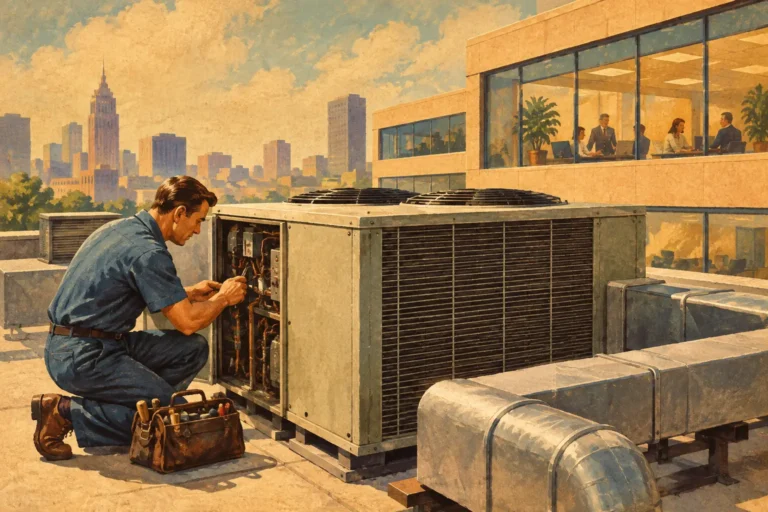
A restaurant dining room that is too warm at lunch, an office with uneven temperatures, or a retail store with a failed rooftop unit can affect far more than comfort. Commercial HVAC plays a direct role in customer experience, employee productivity, equipment protection, indoor air quality, and monthly operating costs. For property managers and business owners, the right service plan prevents a comfort issue from becoming an interruption to business.
Commercial systems have to handle longer operating hours, larger spaces, changing occupancy, and more demanding ventilation needs than most residential equipment. That is why a quick fix is not always the right fix. A qualified contractor should look at the building, the equipment, the controls, and the way the space is actually used before recommending repairs or replacement.
What Makes Commercial HVAC Different?
Commercial HVAC equipment is designed around the needs of a specific building. A small professional office may use split systems similar to residential equipment, while a larger facility may rely on rooftop units, boilers, make-up air systems, ductless zones, or multiple interconnected systems. The equipment itself matters, but so does the design behind it.
A system that is oversized may cycle on and off too frequently, wasting energy and leaving humidity control inconsistent. A system that is undersized can run continuously during extreme Illinois weather without ever reaching a comfortable setpoint. Both conditions can create premature wear and higher utility bills.
Ventilation also deserves close attention. Businesses bring together people, products, electronics, and sometimes processes that affect air quality. Fresh-air requirements, filtration, humidity levels, and exhaust needs vary widely between an office, medical practice, restaurant, warehouse, and retail location. There is no single commercial HVAC solution that fits every building.
The Real Cost of Inconsistent Comfort
When heating or cooling is unreliable, the first cost is often obvious: an emergency repair. The less visible costs can be just as significant. Employees may struggle to focus, customers may leave sooner than planned, inventory may be exposed to unfavorable conditions, and business owners may lose time managing complaints instead of serving customers.
Poor temperature control can also point to an underlying issue rather than a simple thermostat adjustment. Restricted airflow, leaking ductwork, dirty coils, failing motors, refrigerant problems, or outdated controls can all force equipment to work harder than it should. Addressing the root cause helps protect the system and the operating budget over time.
Signs Your Commercial HVAC System Needs Attention
Commercial equipment does not always fail without warning. Many service calls begin with smaller changes that have been easy to overlook during a busy season. A building that feels different from one area to another, takes longer to heat or cool, or produces unusual sounds is worth evaluating before the problem grows.
Pay attention when utility costs rise without a clear change in business activity. Watch for rooms that stay too hot or too cold, frequent thermostat adjustments, persistent humidity, musty odors, water near equipment, or repeated breaker trips. These issues may be connected, especially in systems that have not received regular maintenance.
Age is another factor, but it should not be the only factor. Well-maintained equipment can often deliver dependable service beyond an expected lifespan, while neglected equipment may become costly much earlier. The key question is not simply whether the system can be repaired. It is whether the repair is likely to provide dependable performance at a reasonable cost.
Repair or Replace? Start With the Right Questions
A repair can make sense when the equipment has been maintained, the issue is isolated, and efficiency remains acceptable. Replacing a failed component may restore reliable operation without a major capital expense. This is often the practical choice for newer equipment with a solid service history.
Replacement becomes more compelling when repair calls are frequent, parts are difficult to obtain, energy use is excessive, or the system cannot maintain comfort across the building. It may also be time to replace equipment when a business has remodeled, added staff, changed operating hours, or repurposed part of the property. The original system may no longer match the load it needs to serve.
A professional assessment should include equipment condition, repair history, capacity, airflow, controls, and projected operating costs. Business owners deserve clear options, not pressure. Sometimes a targeted repair and a maintenance plan are the right next steps. Other times, a high-efficiency replacement offers better long-term value and fewer disruptions.
Commercial HVAC Maintenance Is Business Protection
Preventive maintenance is one of the most effective ways to reduce unexpected HVAC downtime. It gives technicians an opportunity to find worn parts, airflow restrictions, electrical concerns, drainage problems, and control issues before they become an emergency on a hot afternoon or during a winter cold snap.
A thorough visit goes beyond changing filters. Depending on the equipment, service may include checking refrigerant performance, cleaning coils, inspecting belts and motors, testing safety controls, verifying electrical connections, clearing condensate drains, reviewing thermostat operation, and confirming that airflow is reaching occupied areas. Each task supports efficiency, comfort, and system life.
The right schedule depends on the building and equipment. Many commercial properties benefit from service before cooling season and again before heating season. Restaurants, high-occupancy spaces, facilities with sensitive equipment, and businesses that operate long hours may need more frequent attention. Filters alone may require more frequent changes when dust, foot traffic, or process contaminants are high.
Maintenance also provides useful documentation. For property managers, a service history can support budgeting, help identify recurring concerns, and make future replacement decisions more informed. It is easier to plan a capital project around business operations than to react after a system fails.
Better Controls Can Improve Comfort and Efficiency
Modern controls give businesses more visibility into how their HVAC equipment is performing. Smart thermostats and programmable controls can reduce unnecessary runtime by matching heating and cooling schedules to actual occupancy. Zoning can help address areas with different sun exposure, occupancy levels, or operating hours.
Controls are not a cure for every comfort problem. If ductwork is undersized, a unit is failing, or airflow is restricted, a new thermostat will not solve the underlying issue. But when the equipment and air distribution are in good condition, thoughtful controls can reduce energy waste while giving managers better temperature oversight.
Humidity control is another area where the details matter. Excess humidity can make a space feel warmer than the thermostat setting suggests, while overly dry winter air can affect occupant comfort and some materials. The best approach depends on the building’s use, ventilation requirements, and existing equipment.
Indoor Air Quality Belongs in the Conversation
A comfortable temperature is only part of a healthy commercial environment. Filtration, ventilation, humidity, and equipment cleanliness all influence indoor air quality. Businesses with allergy-sensitive occupants, customer-facing spaces, or high indoor traffic may benefit from a review of filtration options and air purification strategies.
Higher-efficiency filtration can capture more airborne particles, but it must be matched to the system. A filter that is too restrictive for the equipment can reduce airflow and create new performance issues. This is one reason professional guidance matters. The goal is cleaner air without compromising the system’s ability to heat and cool effectively.
Choosing a Commercial HVAC Partner
Commercial service requires technical skill, responsiveness, and respect for the demands of running a business. Look for a contractor with trained technicians, experience across system types, a clear diagnostic process, and the ability to support both urgent repairs and long-term planning. Availability matters when a comfort failure threatens business operations, but so does the quality of the work performed after the technician arrives.
Ask how the contractor approaches maintenance, replacement recommendations, and communication with facility contacts. The best relationship is not built around a single emergency call. It is built on consistent service, honest guidance, clean workmanship, and a clear understanding of your property.
For businesses in Elgin and the surrounding Northeast Illinois communities, Lea Heating & Air Conditioning brings more than 48 years of local experience, factory-trained and NATE-certified expertise, and 24/7 emergency support to commercial comfort needs. Whether the immediate need is a repair, a maintenance strategy, or a system upgrade, the focus should remain on dependable performance and practical value.
A well-maintained HVAC system rarely calls attention to itself, and that is exactly the point. When employees can work comfortably, customers can stay focused on why they came in, and managers can plan instead of reacting, the building is doing its job. Schedule service before the next weather swing turns a manageable concern into a business interruption.