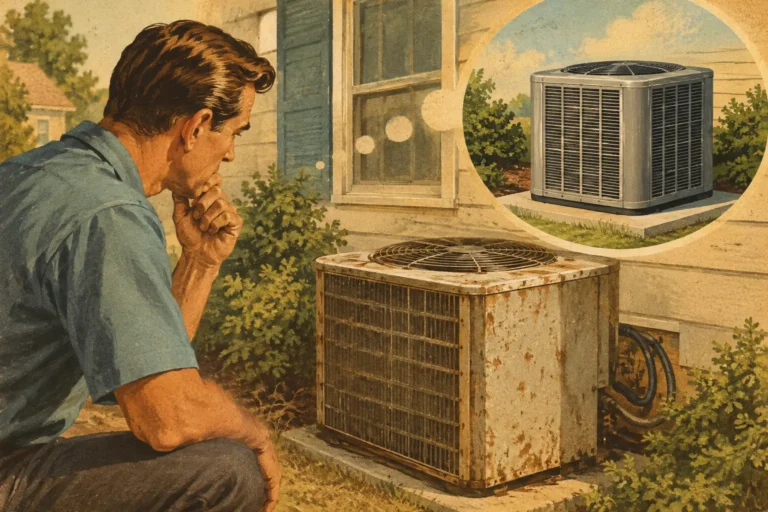
A midsummer AC failure is frustrating. But an air conditioner does not have to quit completely before replacement becomes the smarter financial and comfort decision. If you are asking when should AC be replaced, look beyond whether the system still turns on. Its age, repair history, efficiency, refrigerant, and ability to keep every room comfortable tell the fuller story.
For homeowners and business owners in Northeast Illinois, the right answer is rarely a simple number of years. A well-maintained system may provide dependable service longer than expected, while a neglected or undersized unit can become costly well before its time. A professional evaluation can put the condition of the equipment in context and help you choose between a targeted repair and a planned replacement.
When Should AC Be Replaced? Start With Age
Most central air conditioners last about 12 to 15 years. Some systems run longer with consistent maintenance, clean coils, proper refrigerant charge, and limited strain during hot weather. Still, once an AC reaches the 10-year mark, it makes sense to weigh larger repair costs against the value of a new system.
Age alone does not require replacement. A 12-year-old unit with a minor electrical issue may be an excellent repair candidate. On the other hand, a 9-year-old system with a major refrigerant leak, repeated compressor problems, and poor humidity control deserves a closer look.
Older equipment also tends to be less efficient than current models. If your cooling bills have steadily climbed even though your usage has not changed much, declining performance may be part of the reason. Newer high-efficiency equipment can use variable-speed technology and improved controls to deliver steadier temperatures while reducing wasted energy.
Signs Your Air Conditioner Is Nearing the End
A single repair does not automatically mean it is time for a replacement. Patterns matter more. Frequent service calls, especially for different components, can indicate that several parts are wearing out at once.
Pay attention if the system struggles to cool the home or business during normal summer conditions. Long run times, warm air from supply vents, uneven temperatures between rooms, excess indoor humidity, or repeated cycling on and off all deserve professional attention. These symptoms can come from a repairable issue, such as a failing capacitor, clogged coil, duct leak, or thermostat problem. They can also reveal an aging system that no longer has the capacity or control needed for the building.
Unusual sounds are another warning. Rattling may be a loose component, while grinding, screeching, or loud electrical buzzing can signal more significant mechanical trouble. Water around the indoor equipment should also be addressed promptly. A clogged condensate drain may be straightforward to clear, but ongoing moisture can damage ceilings, floors, and equipment.
Four situations often make replacement worth serious consideration:
- The AC needs a major repair, such as a compressor or outdoor coil, after it is already near or beyond its expected service life.
- Repair bills are becoming routine, rather than occasional and predictable.
- The system uses R-22 refrigerant, which is no longer produced or imported for new use and can be expensive to source when needed.
- Comfort problems continue after appropriate repairs and maintenance, particularly if parts of the building are consistently too warm or humid.
Compare the Repair Cost With the System’s Remaining Value
The repair-versus-replace decision should account for more than the invoice in front of you. A low-cost repair that gives a relatively young unit several more reliable years is usually sensible. A costly repair on a 14-year-old unit may restore cooling temporarily while leaving other aging components at risk.
Some homeowners use the “50 percent rule,” replacing equipment when a repair approaches half the cost of a new system. It is a useful starting point, not a universal rule. A repair below that threshold may still be hard to justify if the unit has a history of breakdowns, uses obsolete refrigerant, or cannot meet your comfort needs. Conversely, a larger repair may make sense on a newer, well-maintained system still covered by a meaningful parts warranty.
Ask for clear options: the immediate repair, its expected benefit, the condition of related components, and the estimated cost of replacement. This gives you room to make a planned decision instead of choosing equipment under the pressure of an outage.
For commercial properties, the calculation also includes business disruption. An unreliable rooftop unit or split system can affect employee comfort, customer experience, inventory, and operating hours. A planned replacement may be easier to schedule and budget than repeated emergency repairs during peak cooling season.
Efficiency Matters, but Proper Sizing Matters More
A new AC can lower energy use, but the highest rated system is not automatically the best choice. Equipment must be sized for the building, insulation levels, window exposure, occupancy, ductwork, and cooling load. An oversized unit can cool quickly but cycle off before removing enough humidity. An undersized unit may run continuously and still fall behind on hot days.
A qualified contractor should evaluate the whole system rather than simply replace the outdoor unit with the same size. That means checking the indoor coil, refrigerant lines, electrical connections, condensate drainage, airflow, and duct condition. In some homes, sealing duct leaks, correcting return-air issues, or improving insulation has a meaningful effect on comfort and equipment performance.
Modern options can also address specific frustrations. Variable-speed systems can make quieter, smaller adjustments instead of repeatedly starting at full output. Smart thermostats help households manage schedules and monitor energy use. Zoning can improve temperature control in multi-level homes or areas with very different sun exposure. These upgrades are not necessary for every replacement, but they are worth discussing when uneven comfort has been an ongoing problem.
Do Not Ignore Refrigerant and Indoor Air Quality
If an older air conditioner uses R-22, a refrigerant leak creates a different decision than it would on a newer unit. R-22 is available only through existing or reclaimed supplies, so the cost of recharging a leaking system can be high. More importantly, simply adding refrigerant without finding and correcting the leak is not a lasting solution.
Replacement is often the more practical path when an R-22 system has a substantial leak or needs major sealed-system work. Today’s systems use newer refrigerants and are designed to meet current efficiency standards, but installation quality remains essential. Proper evacuation, refrigerant charging, airflow setup, and commissioning all affect reliability and performance.
A replacement conversation is also a good time to consider indoor air quality. High humidity, persistent dust, uneven airflow, and allergy concerns may be connected to the HVAC system but may not be solved by the AC alone. Filtration, humidity control, duct improvements, and air-cleaning options should be tailored to the property and the people using it.
Plan the Replacement Before an Emergency
The best time to replace an aging air conditioner is often before the hottest week of the year exposes its limits. Planning ahead allows time to compare efficiency levels, evaluate financing options, select features that fit your property, and schedule work with less urgency. You also avoid putting another major repair into equipment you already expect to replace soon.
Regular maintenance helps make that planning possible. During a seasonal visit, a technician can identify worn electrical components, drainage problems, low airflow, dirty coils, and unusual operating pressures before they turn into a no-cooling call. Maintenance does not make equipment last forever, but it provides the information needed to budget realistically and protect the years of service that remain.
Lea Heating & Air Conditioning brings factory-trained, NATE-certified expertise to replacement evaluations, with attention to the equipment and the conditions around it. The goal is not to push replacement when a repair is appropriate. It is to give you a clear picture of cost, reliability, efficiency, and comfort so the decision fits your home or business.
If your AC is aging, needs frequent repairs, or is no longer keeping the space comfortable, schedule an evaluation before the next heat wave makes the decision for you. A well-chosen replacement can turn an uncertain cooling season into dependable comfort for years ahead.