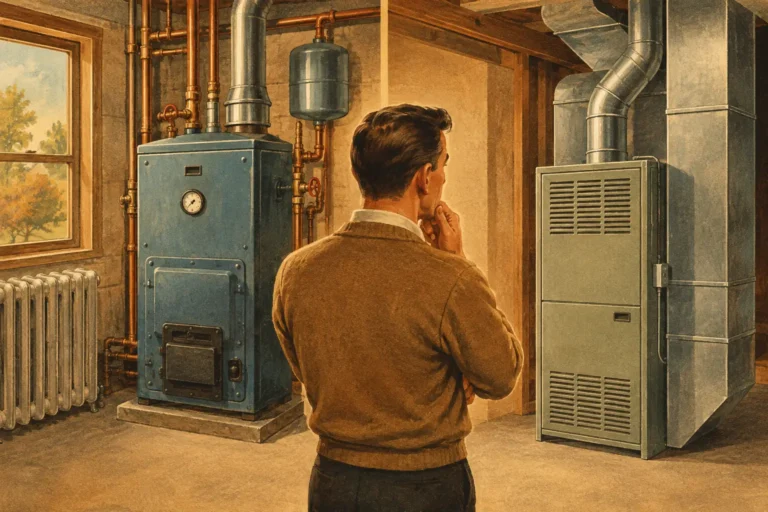
A Chicago-area winter exposes the strengths and limitations of a heating system quickly. If some rooms feel dry and drafty while others overheat, or if a radiator takes too long to warm up, the boiler versus furnace question becomes more than a technical comparison. It is about how your home feels on the coldest morning of the year, what it costs to operate, and what equipment makes sense when replacement time arrives.
Both systems can provide reliable, efficient heat. The better choice depends on your home’s existing infrastructure, comfort priorities, fuel options, budget, and plans for cooling. A qualified HVAC assessment should look beyond the equipment label to consider sizing, insulation, ductwork or piping condition, and the way your household actually uses each space.
Boiler Versus Furnace: The Basic Difference
A furnace heats air and distributes it through ducts using a blower. In most Northeast Illinois homes, the furnace burns natural gas, although electric and oil models also exist. Warm air travels through supply vents, while return ducts bring cooler air back to the unit to be reheated.
A boiler heats water rather than air. That hot water, or in some older systems steam, moves through pipes to radiators, baseboards, or radiant-floor tubing. The heat then radiates gently into the room. Boilers may use natural gas, propane, oil, or electricity, depending on the model and the property.
This difference affects nearly every part of the ownership experience. A furnace is part of a forced-air system, which can also support central air conditioning, filtration, humidification, and certain indoor-air-quality accessories. A boiler is part of a hydronic system, valued for its even, quiet warmth, but it usually needs separate equipment for whole-home air conditioning.
Comfort: Moving Air Versus Radiant Heat
Many homeowners notice the comfort difference before they understand the mechanical difference. Forced-air heat reaches a set temperature relatively quickly, which is useful when the thermostat has been turned down overnight or a commercial space needs a fast warm-up. The trade-off is that air movement can create mild drafts, carry dust if filtration is neglected, and produce greater temperature variation between rooms.
Boiler heat tends to feel more gradual and consistent. Radiators and radiant floors warm nearby surfaces and occupants, so rooms can feel comfortable without the noticeable airflow of a furnace. Radiant-floor systems are especially appealing in bathrooms, basements, and rooms with tile flooring.
Neither experience is automatically better. A properly designed variable-speed furnace with balanced ducts can deliver exceptionally consistent comfort while operating quietly. Likewise, an aging boiler with poorly balanced radiators, failing circulators, or outdated controls can leave parts of a home chilly. Installation quality and maintenance matter as much as the type of heat.
Humidity and indoor air considerations
Because furnaces circulate air, they can be paired with whole-home humidifiers, high-efficiency filtration, UV air purifiers, and fresh-air solutions. That flexibility can be valuable for families concerned about dry winter air, allergies, or airborne particles.
Boilers do not blow air, which means they do not spread dust through ducts. They also do not dry the air in the literal sense, although heated winter air can still feel dry as indoor relative humidity drops. Homes with boilers can use standalone or integrated humidity and air-cleaning solutions, but the approach is typically more customized.
Efficiency Depends on Equipment and the Home
Modern high-efficiency furnaces can achieve annual fuel utilization efficiency ratings of 95% or more. High-efficiency condensing boilers can reach similar levels. In simple terms, both can convert a large share of their fuel into usable heat when they are correctly sized, installed, and maintained.
A high efficiency rating does not guarantee low utility bills on its own. An oversized furnace may cycle on and off too often. Leaky ducts can waste heated air in an attic, crawl space, or unfinished basement. A boiler may lose performance if its controls are outdated, pipes are poorly insulated, or the system is not balanced across heating zones.
For a replacement project, the contractor should perform a load calculation rather than selecting equipment based only on the size of the old unit. The right capacity accounts for square footage, ceiling height, windows, insulation, home orientation, and local winter design temperatures. This is one of the most meaningful steps in protecting comfort and energy performance.
Installation Cost and Replacement Practicality
For a home that already has functioning ductwork, replacing a furnace is often more straightforward than converting to a boiler. The same is generally true in reverse: if a home has radiators or hydronic baseboards in good condition, installing a new boiler can be a sensible path with less disruption.
Changing from one system type to another can be a major renovation. Adding ducts to a home built around radiators may require soffits, wall openings, and careful planning around finished areas. Converting from forced air to hydronic heat involves adding piping, emitters, and potentially new electrical or venting requirements. The project can be worthwhile for a substantial remodel, but it is rarely a simple equipment swap.
Homes with boiler heat also need a separate cooling strategy if central air is desired. Ductless mini-splits can provide efficient cooling and supplemental heating without adding full ductwork. High-velocity systems or conventional central air may fit some homes, depending on their construction. The best option should be based on the home’s layout rather than a one-size-fits-all recommendation.
Maintenance and Service Needs
Both systems deserve annual professional maintenance before the heating season. A furnace tune-up typically includes checking combustion, inspecting the heat exchanger, cleaning components, testing safety controls, evaluating airflow, and replacing or checking the filter. Filter changes between visits remain an important homeowner responsibility.
Boiler maintenance includes combustion and safety checks, an inspection for leaks or corrosion, pressure verification, expansion-tank evaluation, and testing of circulators, valves, and controls. Steam boilers have additional maintenance considerations, including water-level controls and proper piping performance.
Furnaces have more moving air-related components, especially the blower and duct system. Boilers have pumps, valves, piping, and water-pressure components. Neither is maintenance-free, and both need prompt attention when warning signs appear.
Call for service if a furnace begins making banging or squealing sounds, cycles repeatedly, has weak airflow, or produces unusual odors. Boiler concerns include water around the unit, pressure changes, cold radiators, noisy pipes, or a system that repeatedly needs water added. If you smell gas or a carbon monoxide alarm activates, leave the building and contact emergency services and your utility provider before arranging HVAC service.
Which System Is Right for Your Property?
A furnace often makes the most sense for homes that already have ducts, want central air conditioning through the same distribution system, or need the flexibility to add whole-home air-quality equipment. It can also be a practical choice for many commercial spaces that require fast recovery and centralized control.
A boiler may be the stronger choice when a home already has a well-maintained hydronic system, the owner values quiet radiant comfort, or zoning is a high priority. Hydronic heating can serve different areas with separate thermostats and control valves, though forced-air zoning is also possible when the duct design and equipment support it.
For older homes in Elgin, Barrington, Crystal Lake, and surrounding communities, preserving a dependable radiator system can be an excellent decision. For a newer home with central ductwork and an aging gas furnace, upgrading to a properly sized high-efficiency furnace may be the most cost-effective path. The answer depends on the home, not on a universal winner.
Make the Decision With a Full-System View
Before replacing either system, ask for clear options that compare equipment efficiency, expected installation scope, warranty coverage, controls, maintenance needs, and cooling implications. A low initial price can become less appealing if it leaves unresolved duct issues, inconsistent rooms, or an outdated thermostat that limits performance.
Lea Heating & Air Conditioning brings factory-trained, NATE-certified expertise to these conversations, with recommendations built around the property and the people using it. Whether you are managing an urgent no-heat call or planning a long-term upgrade, the goal is dependable warmth, safe operation, and a system you can feel confident relying on when winter settles in.