A second-floor bedroom that never cools down, an older Elgin home without ducts, and an office addition with hot afternoons can all lead to the same question: central air versus ductless cooling. Both can provide reliable summer comfort, but they solve different problems. The better choice depends on your building layout, existing equipment, renovation plans, comfort priorities, and budget.
Central air remains a strong whole-home solution when ductwork is in good condition. Ductless cooling, often called a mini-split system, offers targeted temperature control without requiring supply and return ducts. Neither option is automatically right for every property. A professional load calculation and an honest look at the building are what turn a cooling purchase into a long-term comfort solution.
Central Air Versus Ductless Cooling: The Core Difference
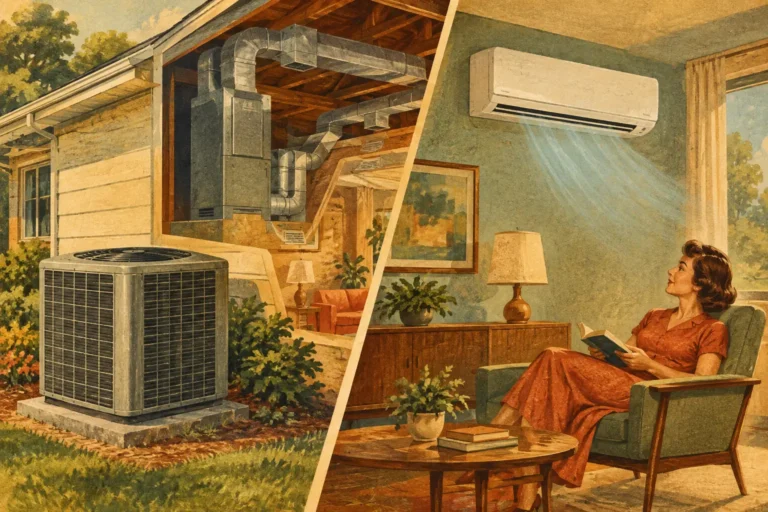
A central air conditioner uses one outdoor condensing unit and an indoor evaporator coil, usually installed with a furnace or air handler. Conditioned air travels through ductwork to rooms throughout the home or business. A thermostat controls the system, although zoning equipment and smart thermostats can add more precision.
A ductless system uses an outdoor unit connected to one or more indoor air handlers by small refrigerant lines and wiring. Each indoor unit serves a specific room or zone and has its own temperature control. The installer does not need to run large ducts through walls, attics, or crawlspaces, which makes ductless equipment especially useful in homes with limited access for ductwork.
The difference is not simply central system versus wall unit. Modern ductless systems are engineered HVAC equipment with variable-speed technology, filtration, condensate drainage, and carefully sized refrigerant lines. Proper design and installation matter just as much as the equipment itself.
When Central Air Is the Better Fit
Central air is often the practical choice for a home that already has a forced-air furnace and well-designed ducts. If every room needs cooling at roughly the same time, one properly sized central system can deliver consistent whole-home comfort without placing an indoor unit in each living area.
For many homeowners, the appearance of the system is also a factor. Central air keeps the major components out of sight, with only registers and returns visible indoors. It can be a natural replacement option when an existing air conditioner is aging, especially if the furnace, coil, and ductwork are compatible with a high-efficiency upgrade.
Central systems can also support whole-home accessories. Depending on the equipment and duct design, that may include advanced filtration, humidification, UV air purification, and zoning controls. For families concerned about comfort and indoor air quality across the entire house, this integrated approach has real value.
That said, central air depends heavily on the duct system. Leaky, undersized, poorly insulated, or unbalanced ducts can waste energy and create frustrating temperature differences between rooms. Replacing the outdoor unit alone will not correct a ductwork problem. In some cases, duct repairs, balancing, or zoning should be part of the project scope.
Where Ductless Cooling Makes Sense
Ductless cooling is especially effective when extending or installing ductwork would be disruptive or costly. Common applications include finished basements, attic conversions, sunrooms, garages, home offices, additions, older homes, and individual rooms that never seem to match the rest of the house.
Because each indoor head serves a zone, ductless systems give occupants direct control. A couple may keep the bedroom cooler at night without overcooling the first floor. A business can condition a server room, conference room, or office addition without running the main system longer than necessary. This room-by-room control can reduce energy waste when only part of a building is occupied.
Many ductless heat pumps also provide heating, making them useful beyond the cooling season. In Northeast Illinois, a cold-climate heat pump can supplement a furnace or serve selected spaces efficiently during milder weather. However, winter performance and backup heat requirements should be discussed carefully. Equipment selection must account for local design temperatures, the building envelope, and how the space will be used.
The indoor units are visible, which some homeowners see as a drawback. Wall-mounted units are common, but ceiling cassettes, floor-mounted models, and concealed ducted options may be available depending on the application. A good design considers sightlines, airflow, service access, and how the equipment will look in the finished room.
Cost Is More Than the Equipment Price
Comparing purchase prices alone can be misleading. A central air replacement may cost less upfront when usable ductwork and a compatible furnace are already in place. If ducts must be added throughout an older home, however, installation labor and construction work can make central air far more expensive.
Ductless systems can avoid much of that disruption, but multi-zone installations are not necessarily inexpensive. Each indoor zone requires equipment, refrigerant piping, electrical work, drainage, and careful commissioning. A single ductless unit for a sunroom is a very different project from a whole-home multi-zone system.
Operating costs also vary. High-efficiency central air and ductless systems can both lower energy use compared with older equipment. Ductless units often gain an advantage in lightly used areas because they cool only the occupied zone. Central air may be more economical for a home where the entire space is occupied daily and the duct system is tight, insulated, and properly balanced.
Efficiency ratings help, but they should not be the only deciding factor. An oversized high-efficiency system can short cycle, remove less humidity, and wear prematurely. An undersized system may struggle during a heat wave. Correct sizing starts with a room-by-room load calculation rather than square footage alone.
Comfort, Humidity, and Noise
Cooling is about more than reaching a thermostat setting. A system should manage humidity, move air comfortably, and avoid wide temperature swings. Central air distributes conditioned air broadly, which can create an even feel throughout a well-designed home. Variable-speed systems can improve humidity control by running longer at lower output when conditions allow.
Ductless systems deliver air directly into the rooms they serve. That can be ideal for a stubborn hot room, but the indoor unit must be located correctly. Poor placement can send airflow across a bed, desk, or seating area in a way that feels drafty. It may also leave adjoining rooms without enough circulation.
Both options can operate quietly when selected and installed properly. Ductless indoor units are generally quiet, while central systems may produce more audible airflow if ducts are restrictive or registers are poorly located. Noise concerns are another reason to evaluate the complete system, not just the outdoor unit.
Maintenance Requirements Are Different, Not Optional
Every cooling system benefits from routine professional maintenance. Central air service includes checking refrigerant performance, electrical components, condensate drainage, blower operation, coils, and airflow. Homeowners should also replace or clean filters on schedule, because a clogged filter restricts airflow and can affect comfort and equipment reliability.
Ductless systems need the same level of professional attention, along with regular cleaning of indoor filters, coils, blower wheels, and condensate components. Since the indoor heads handle air directly in occupied rooms, neglected cleaning can affect airflow, odor, and system performance. Multi-zone systems also require technicians who understand how to diagnose controls and refrigerant circuits across multiple indoor units.
For either system, preventive maintenance is less disruptive than waiting for a failure during the hottest week of summer. It also gives a technician an opportunity to identify drainage, electrical, or airflow issues before they become a no-cooling call.
Questions to Settle Before Choosing
Start with the building, not a preferred product. Does the property have ducts, and are they properly sized and sealed? Are you cooling the whole home or solving a problem in one area? Is there a planned addition, renovation, or change in occupancy? Do different family members need different temperatures in separate rooms?
For commercial properties, also consider operating hours, occupied zones, equipment heat loads, tenant needs, and downtime risk. A ductless system may be a smart targeted solution, while a central system may better support a larger, consistently occupied area. In some buildings, the best answer is a hybrid approach: central air for the main space and ductless equipment for an addition, bonus room, or persistent trouble spot.
A qualified HVAC contractor should inspect existing ducts, electrical capacity, insulation, drainage paths, outdoor-unit location, and the condition of related equipment. Ask for clear options, expected comfort results, maintenance needs, and any work required beyond the equipment itself. The right proposal should explain why a system is recommended, not merely present a model number.
Lea Heating & Air Conditioning helps homeowners and businesses evaluate those details with factory-trained, NATE-certified expertise and a focus on clean, dependable workmanship. Whether the answer is a central replacement, a ductless zone, or a combined design, the goal is the same: dependable comfort that fits the way your space is actually used.
Before the next heat wave makes the decision urgent, schedule a professional evaluation and give the conversation a practical starting point: which rooms need better comfort, when are they occupied, and what is your current system failing to do?