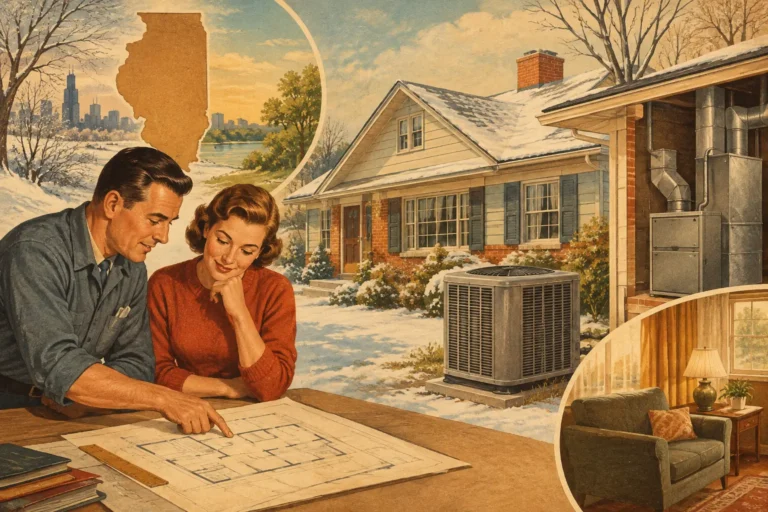
A replacement furnace, air conditioner, or heat pump should not be sized by what was installed before. Your current equipment may be oversized, undersized, or compensating for ductwork and insulation problems that were never addressed. This home HVAC system sizing guide explains what proper sizing involves, why it affects comfort and operating costs, and what to expect before selecting a new system.
For homeowners in Elgin and throughout Northeast Illinois, sizing also has to account for humid summers, cold winters, and homes that range from older construction to recently updated, tightly sealed spaces. The right answer is rarely found on an equipment nameplate alone.
Home HVAC System Sizing Guide: Start With the Load
HVAC sizing begins with a heating and cooling load calculation. This calculation estimates how much heat your home gains in summer and loses in winter under local design conditions. Rather than relying on square footage alone, a qualified contractor evaluates the home itself.
A professional load calculation, often called a Manual J calculation, considers conditioned square footage, ceiling height, window size and direction, insulation levels, air leakage, exterior walls, basement conditions, and the number of people regularly using the space. It also accounts for appliances, lighting, and solar heat entering through windows.
Square footage is useful as a starting point, but it cannot determine capacity by itself. Two 2,000-square-foot homes can need very different systems. One may have a vaulted great room, original windows, and a sun-facing wall of glass. The other may have upgraded insulation, shaded windows, and a finished basement. Selecting the same size system for both can create comfort problems from day one.
Cooling capacity is commonly measured in tons, with one ton equal to 12,000 BTUs per hour. Heating equipment is rated in BTUs per hour, but furnace efficiency matters too. A 100,000 BTU furnace with a 96% AFUE rating delivers a different amount of usable heat than an older furnace with a lower efficiency rating. The goal is to match delivered capacity to your home’s calculated needs.
Why Bigger Is Not Better
It is understandable to assume extra capacity provides extra comfort. In HVAC, oversizing often does the opposite.
An oversized air conditioner cools the thermostat area quickly and shuts off before it has run long enough to remove adequate humidity. The home may feel cool but clammy, particularly during a typical Illinois summer. Frequent starts and stops can also increase wear on components and reduce efficiency.
An oversized furnace can create noticeable temperature swings. Rooms warm up rapidly, then cool before the next short cycle begins. The system may be louder, and some areas of the home can feel consistently less comfortable than others.
Undersizing has its own consequences. An undersized system may run for long periods during extreme weather, struggle to maintain the thermostat setting, and leave rooms at the far end of the duct system uncomfortable. However, a system that runs continuously during a rare stretch of extreme heat or cold is not automatically too small. Equipment is usually designed for specific outdoor conditions, not every record-breaking day on the calendar.
The best-sized system is one that meets the calculated load efficiently, maintains steady indoor temperatures, and has the airflow to distribute conditioned air throughout the home.
Ductwork Can Change the Sizing Decision
A new high-efficiency HVAC system cannot perform as intended if the ductwork is leaking, restricted, poorly designed, or improperly sized. This is one reason a replacement estimate should look beyond the equipment cabinet.
Supply ducts must deliver the right amount of conditioned air to each room, while return ducts must bring enough air back to the system. A common planning guideline is roughly 400 cubic feet per minute of airflow per ton of cooling, but the final airflow target depends on the equipment, humidity needs, duct design, and manufacturer specifications.
Rooms that are always too hot or too cold may point to a ductwork issue rather than a need for a larger unit. A second-floor bedroom with heavy afternoon sun, for example, might benefit from duct improvements, better insulation, zoning, or a ductless solution. Increasing system size without correcting the underlying issue can make the rest of the home less comfortable.
A thorough evaluation may include checking duct leakage, static pressure, return-air capacity, register placement, and the condition of ducts in attics, crawlspaces, or basements. These details matter because airflow is central to comfort, equipment life, and energy use.
Selecting Capacity for Furnaces, Air Conditioners, and Heat Pumps
Every type of equipment requires a slightly different sizing conversation.
Furnace sizing
A furnace is selected based on the home’s heating load and the unit’s output capacity, not simply its input rating. High-efficiency furnaces convert more of their fuel into usable heat, so replacing an older model with the same input BTU rating may result in more heating output than your home needs.
Variable-speed blowers and two-stage or modulating furnaces can improve comfort by operating at lower output for longer periods when conditions allow. They still need to be properly sized. Advanced features improve control, but they do not replace a careful load calculation.
Air conditioner sizing
Air conditioner selection must balance sensible cooling, which lowers air temperature, with latent cooling, which removes moisture. A correctly sized system should provide dependable cooling while controlling indoor humidity. This balance is especially valuable during mild but humid weather, when an oversized system may satisfy the thermostat before moisture is removed.
Efficiency ratings such as SEER2 can help compare energy use, but the highest-rated unit is not always the best value for every home. Equipment cost, expected runtime, duct compatibility, controls, and comfort priorities should all be part of the recommendation.
Heat pump sizing
Heat pumps provide both heating and cooling, so their sizing requires a careful look at year-round performance. Modern cold-climate heat pumps can be an excellent fit for many Northeast Illinois homes, but capacity changes as outdoor temperatures fall.
A heat pump design should consider its heating output at low temperatures, available electrical capacity, backup heat needs, and whether the home will retain a gas furnace in a dual-fuel setup. The lowest equipment price is not always the lowest long-term operating cost, especially when backup heat runs frequently.
Do Not Rely on the Old System’s Size
The capacity of the equipment being replaced is useful information, but it is not a sizing recommendation. An older system may have been selected using a rule of thumb, installed before insulation upgrades, or oversized because the contractor wanted to avoid complaints during extreme weather.
Home changes can also alter the load. New windows, attic insulation, air sealing, a basement remodel, an addition, or a shade tree removed from the yard can all affect heating and cooling requirements. Even a change in how a home is used can matter. A home office occupied all day has different internal heat gains than a room that sits empty.
When reviewing a proposal, ask how the contractor determined the recommended capacity. You should receive a clear explanation of the load calculation, equipment output, efficiency options, ductwork findings, and any assumptions made about the home. A trustworthy recommendation is tailored to the property instead of treating every similar-sized home alike.
What to Expect From a Professional Sizing Visit
A proper assessment takes more than a quick walk-through. The contractor should measure or verify key areas of the home, ask about comfort concerns, inspect accessible ductwork, and discuss future plans such as finishing a basement or adding onto the house.
It is also helpful to share your utility bills and describe when discomfort occurs. Is the upstairs warmer in summer? Does the system run constantly on very cold mornings? Are some rooms humid, stuffy, or difficult to heat? These observations help identify whether capacity, airflow, controls, insulation, or indoor-air-quality equipment should be part of the solution.
Lea Heating & Air Conditioning uses individualized evaluations to help homeowners compare properly sized options, including high-efficiency furnaces, air conditioners, heat pumps, smart thermostats, zoning, and ductwork improvements. Factory-trained, NATE-certified technicians can explain the practical trade-offs so the decision feels clear rather than overwhelming.
The right HVAC size is not the largest unit your budget can buy. It is the system that fits your home, supports balanced airflow, and gives your family dependable comfort through the hottest afternoons and coldest winter nights. Before committing to replacement equipment, schedule a professional load and ductwork evaluation so your next system is built around how your home actually performs.