A UV air purifier HVAC upgrade is often considered after a homeowner notices persistent odors, allergy irritation, or a damp smell when the air conditioner starts. It can be a valuable indoor-air-quality addition, but it is not a catch-all solution. The right system depends on what is happening inside your HVAC equipment, the condition of your ductwork, and the specific air-quality concern you want to address.
UV technology has a clear job: it uses ultraviolet light to disrupt the DNA of certain microorganisms. When installed and maintained correctly, it can help limit microbial growth in key areas of a heating and cooling system. Understanding where it works best helps you make a sound investment instead of expecting one product to solve every air problem.
What a UV Air Purifier HVAC System Actually Does
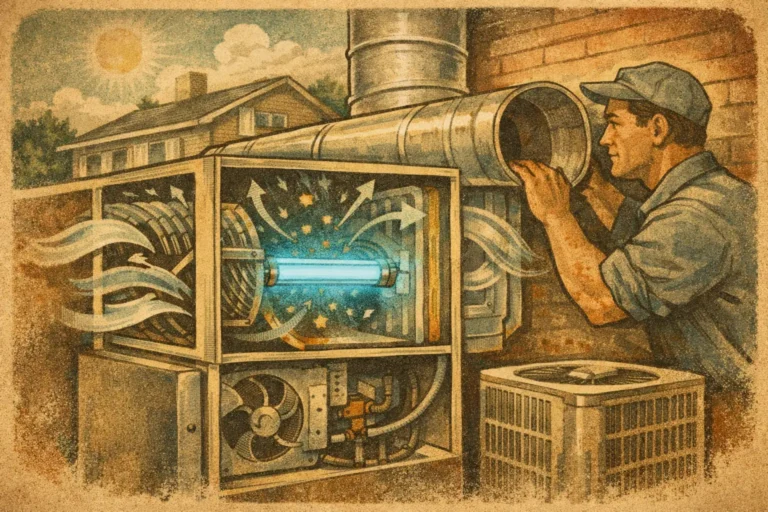
Most HVAC UV systems use UV-C light, a wavelength commonly used for germicidal purposes. Inside an HVAC system, that light is typically installed near the indoor evaporator coil, drain pan, or in the return-air duct. These are areas where moisture, dust, and darkness can create favorable conditions for biological growth.
The most proven application is coil irradiation. During air conditioning season, the evaporator coil removes heat and moisture from indoor air. Condensation forms on the coil and drains away, but some moisture can remain. Over time, buildup on the coil and drain pan can contribute to odors, restricted airflow, and reduced system efficiency. A properly placed UV lamp continuously treats the coil surface to help keep it cleaner.
Some systems are designed to treat moving air as it passes through the duct. These may help reduce exposure to certain airborne microorganisms, but results depend on airflow speed, lamp intensity, exposure time, duct configuration, and installation location. Air moving through a duct does not remain under the light for long, so an air-treatment UV system should be chosen carefully and not viewed as a substitute for filtration.
What UV Lights Do Not Remove From Your Air
A UV light is not a filter. It does not capture dust, pet dander, pollen, lint, smoke particles, or other particulate matter. If these are your primary concerns, a properly sized media air cleaner and regular filter replacement will usually have a more direct impact.
UV lights also do not correct underlying HVAC problems. A clogged drain, poorly insulated ductwork, oversized equipment, excess indoor humidity, or a dirty blower assembly should be repaired rather than covered up with an indoor-air-quality add-on. If a system smells musty, a qualified technician should identify the source before recommending a UV solution.
This distinction matters for homeowners and business owners alike. A restaurant office with recurring odors, for example, may need coil cleaning and ventilation improvements. A family dealing with seasonal pollen may benefit more from upgraded filtration. In some properties, the best answer is both filtration and UV treatment because each product addresses a different part of the air-quality picture.
When a UV Upgrade May Be a Good Fit
UV equipment is often a practical option for homes or commercial spaces with recurring moisture around the indoor coil, noticeable biological odors when the system runs, or occupants who want an added layer of air-quality support. It can also make sense where cooling systems run for long periods, since longer runtime means more opportunity for moisture and buildup at the coil.
In Northeast Illinois, air conditioning systems work through warm, humid stretches of the year, while furnaces can run for months afterward. A clean indoor coil supports airflow in cooling season, and a well-maintained air handler benefits the entire year. For property managers, UV equipment may be particularly useful in buildings where equipment rooms are difficult to access frequently or where reliable maintenance of multiple systems is a priority.
Still, the decision should be based on an inspection. A technician can assess coil condition, drainage, filter type, airflow, humidity levels, and the available space inside the equipment cabinet or ductwork. That evaluation determines whether UV is likely to deliver a meaningful benefit.
Coil Lights vs. Airstream Lights
Coil-mounted lights are aimed at the evaporator coil and drain pan. Their purpose is straightforward: help control microbial growth on surfaces that can stay damp. For many residential systems, this is the most sensible UV application because the lamp remains focused on a stationary target.
Airstream lights are installed in ductwork to treat air moving through the system. They may be appropriate in certain applications, especially when paired with high-quality filtration and correctly designed ductwork. However, their performance is more dependent on equipment selection and system design. A professional should consider the lamp’s output, installation angle, duct size, and the amount of time air is exposed to the light.
Neither option should block service access or create a safety concern. UV-C light can irritate the eyes and skin, so lamps must be enclosed within the HVAC system and installed with appropriate safeguards.
Installation Details Matter More Than the Box
A UV lamp is only as effective as its placement and upkeep. Installing one in the wrong section of a duct, using a lamp with insufficient output, or failing to account for electrical components can limit its value. HVAC equipment also contains materials that may degrade under direct UV exposure, which is another reason proper positioning matters.
Experienced installation begins with the system, not the product. The technician should inspect the air handler or furnace cabinet, locate the coil and drain pan, confirm a safe mounting location, and ensure the light does not interfere with panels, wiring, or future maintenance. The equipment should also be selected for the size and layout of the HVAC system rather than treated as a one-size-fits-all accessory.
For homes with ductless mini-splits, boilers, or other nontraditional equipment, the recommendation may be different. UV solutions are usually associated with forced-air HVAC systems because they rely on access to an air handler, coil, or ductwork. A separate air-cleaning strategy may be more appropriate when ducts are not part of the system.
Maintenance and Operating Costs to Expect
UV lamps need periodic replacement. Although a lamp may still glow after a year, its germicidal output can decline over time. Many HVAC UV lamps are replaced annually, though exact intervals vary by manufacturer and model. A technician can verify output and replace the lamp during routine maintenance.
The electricity use is generally modest, but it is not zero. Homeowners should also factor in replacement lamps and service access when comparing options. These ongoing costs are usually manageable, especially when the UV light helps keep a coil cleaner and reduces the chance of odor-related service concerns, but they should be part of the decision.
Regular HVAC maintenance remains essential. A UV lamp cannot replace filter changes, coil inspections, drain cleaning, blower cleaning, or combustion safety checks on a furnace. Think of it as one component in a well-managed comfort system.
Questions to Ask Before You Install UV Air Purifier HVAC Equipment
Before approving a UV installation, ask what specific problem the equipment is intended to address. A clear answer should connect the recommendation to your system condition, not simply to a general promise of cleaner air. You should also ask whether the proposed light is designed for coil treatment or air treatment, how often the lamp requires replacement, and where it will be installed.
Ask about ozone as well. Properly selected HVAC UV products should be ozone-free. Ozone can be an irritant, particularly for people with asthma or respiratory sensitivities, so it is not a desirable trade-off for indoor air cleaning.
Finally, consider the full indoor-air-quality plan. Filtration, humidity management, ventilation, duct condition, and equipment maintenance all influence the air you breathe. If your filter cabinet allows only a thin, low-efficiency filter, an upgrade there may be worthwhile before adding other products.
A UV light can be a smart addition when it is matched to a real HVAC need and installed by a trained professional. Lea Heating & Air Conditioning can evaluate your equipment, explain the available options clearly, and help you choose an approach that supports cleaner operation and dependable comfort in the spaces you care for every day.